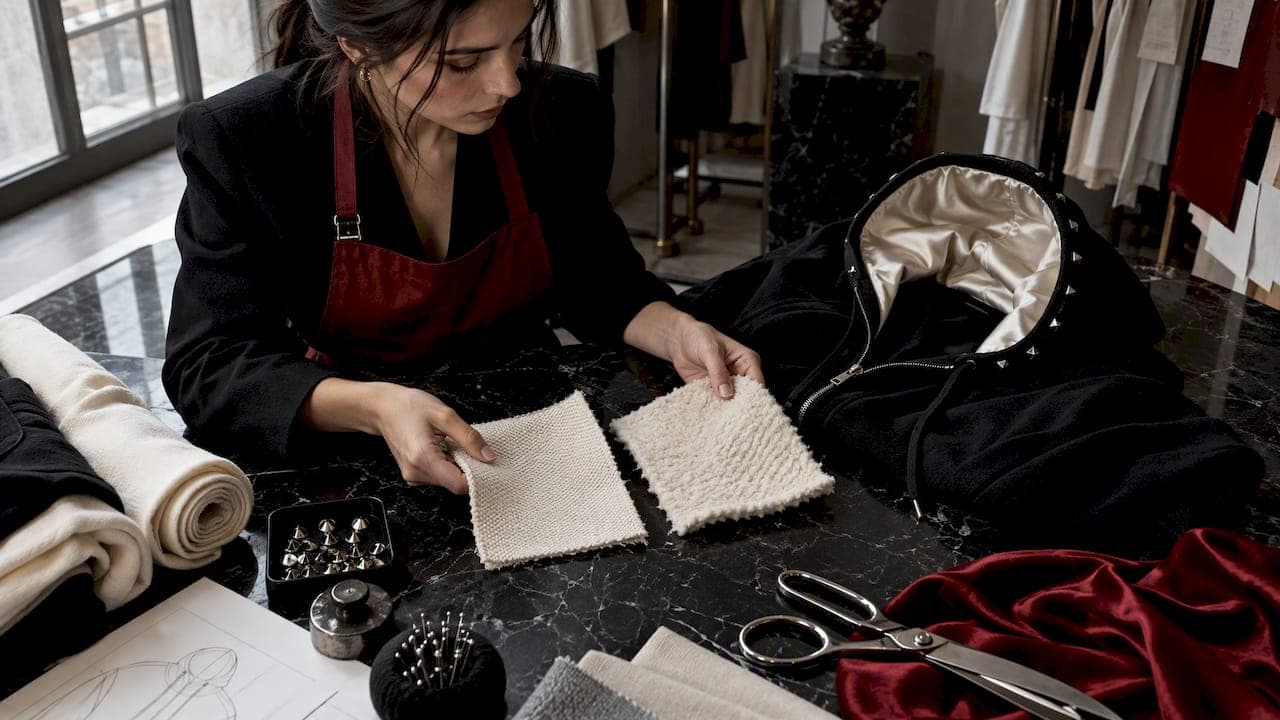
For breathability, year-round comfort and layering, choose French terry. For insulation, plush hand-feel and winter warmth, choose brushed fleece. Weight and finishing decide more than the label alone: a heavy French terry can outperform a light fleece, so the gram weight and the mill's finishing process matter as much as the fabric name itself.
TL;DR:
- Fabrics often undergo finishing processes that significantly impact weight and comfort, making finished swatches more reliable than greige samples.
- French terry maintains its shape and breathability due to intact loops, ideal for layering, while fleece's brushed pile provides superior insulation for cold weather.
- Suppliers recommend requesting detailed swatches, wash tests, and shrinkage data, as brushing and compacting can alter the fabric’s final weight and performance.
- French terry suits midweight, year-round garments at 320-380 GSM, while fleece at 380 GSM or higher is better for winter outerwear and insulation.
- Material choice should always match the garment's function, with French terry for breathable, layered pieces, and fleece for insulation and warmth in outer-layer garments.
Table of Contents
- How the fabrics are made: looped interior versus brushed pile
- Warmth, breathability and moisture behaviour
- GSM, weight bands and what to request on a spec
- Use cases: matching fabric to product role
- Decoration, sewing and care: printing, embroidery and laundering
- How a luxury maison chooses: Jeeyodee's material considerations
- Quick selection checklist and final recommendation
- Maison perspective: why material truth matters
- Jeeyodee atelier offering and call to action
- FAQ
- Sources
How the fabrics are made: looped interior versus brushed pile
Both fabrics begin on the same circular knitting machine, which is precisely why confusion between them persists. The difference appears afterwards, in finishing.
French terry keeps its interior loops intact and uncut, leaving a textured, looped reverse face that stays close to the body without excess bulk. Brushed fleece takes that same looped base and mechanically teases the loops into a raised pile, a process that builds loft and traps air but also weakens yarn twist in the process.
- French terry: uncut loops, flatter hand, more structured drape.
- Fleece: brushed pile, softer hand, looser drape and more bulk.
- Construction detail: two-end knits typically yield un-napped French terry, while three-end knits are built for brushing.
That brushing step explains why fleece feels indulgent against the skin, and why French terry holds its shape along seams and ribbing with less distortion over time.
Warmth, breathability and moisture behaviour
The loops left standing in French terry allow air and moisture to move, which is why it reads as the breathable choice for layering and transitional climates. Brushed fleece traps body heat within its raised pile, which is precisely what makes it preferable for cold-weather garments at a comparable weight.
Breathability matters most where the garment sits close to activity: a mid-layer hoodie, a piece worn under a coat, anything that will see a rise in body temperature. Insulation matters most where the hoodie is the outer layer against genuine cold.
Two fabrics at an identical gram weight can still behave quite differently depending on fibre blend and how aggressively the mill has brushed or compacted the cloth, so weight alone never tells the whole story.
GSM, weight bands and what to request on a spec
Gram weight is a useful shorthand, but it only becomes meaningful once you know how the fabric was finished. Supplier guidance places both fabrics across overlapping ranges, so a finished swatch, not a greige sample, is what a spec should be built around.
| Weight band | Typical GSM | Best suited to |
|---|---|---|
| Light | 280 | Transitional French terry, summer layering |
| Mid | 280-380 | Year-round hoodies, printed styles |
| Heavy | 380-500+ | Winter fleece, outer-layer hoodies |
Before confirming an order, request a finished swatch, a wash test, documented shrinkage figures and a sewn sample. Brushing and compacting can shift a fabric's final weight considerably from its greige state, which is why the swatch, not the spec sheet, has the final word.
Use cases: matching fabric to product role
The right fabric follows the garment's job, not a general preference for one or the other.
- French terry suits midweight hoodies, layering pieces and any style built around fine print detail.
- Fleece suits heavyweight winter hoodies, loungewear and outer-layer garments where warmth is the primary brief, as shown in the hoodie collection of quality winter garments.
- Hybrid constructions, such as a fleece-lined hood over a French terry body, let a designer combine structure with warmth where the brief calls for both.
A piece meant to be worn alone in cold weather calls for fleece. A piece meant to be layered, printed or worn across seasons calls for French terry, and testing both at the intended weight remains the only reliable way to settle a borderline brief.
Decoration, sewing and care: printing, embroidery and laundering
French terry's smooth, looped face favours fine-detail screen printing and DTG, while napped fleece should always be test-printed first, since the raised pile can blur sharp linework.
- Confirm the backing and tension settings before embroidering fleece, as the pile sheds more lint during stitching than a flat terry face.
- Wash test both fabrics at the intended care temperature to document shrinkage before bulk production.
- Inspect for pilling after repeated washes, since brushed fleece is more prone to it than an un-napped terry.
- Check rib and cuff recovery after laundering to confirm the knit has held its shape.
A well-finished French terry can, in fact, look more resilient after several washes than a fleece whose pile has begun to flatten, which is worth weighing against fleece's warmer first impression.
How a luxury maison chooses: Jeeyodee's material considerations
At Jeeyodee, the choice between a looped interior and a brushed pile is never incidental. Heavyweight French terry is selected where structure and printed clarity matter to the silhouette, while a brushed interior is reserved for pieces built around heirloom softness.
Before any fabric is approved, we examine hood collapse, rib recovery and hand-feel after washing, the same scrutiny any atelier applies before committing cloth to a one-time production run.

Pro Tip: Balance perceived luxury against function: a plush hand feels expensive on the rail but should never come at the cost of how the garment wears a year on.
Quick selection checklist and final recommendation
Choose by season, by layer and by decoration priority. A piece worn alone in cold weather calls for brushed fleece; a piece built for layering, printing or year-round wear calls for French terry.
As a working spec: French terry at 320-380 GSM suits a printed, year-round hoodie, while brushed fleece at 380-500+ GSM suits a winter outer-layer piece. Always approve the finished swatch and wash test before committing to bulk.

Maison perspective: why material truth matters
Fabric honesty is where craftsmanship begins. An interior finish is never a technicality to us; it decides how a garment ages, how it drapes and whether it earns the right to be called collectible, which is the standard every Jeeyodee piece answers to.
— Jeeyodee
Jeeyodee atelier offering and call to action
Each garment in a luxury collection applies the same material discipline: heavyweight cotton, paired with a silk hood lining and carefully aligned cone studs, handcrafted with attention to detail and individually numbered. Each collection drop is produced once and not reproduced.

- View the current limited drop at the Jeeyodee store.
- Contact the atelier directly to discuss bespoke material notes for a commission.
FAQ
Which is better, fleece or French terry?
Neither is universally better; the right choice depends on the garment's role. Fleece suits insulation and winter outer layers, while French terry suits breathable, year-round and layering pieces, so the decision follows climate and use rather than a fixed hierarchy.
What are the downsides of French Terry fabric?
French terry offers less insulation than brushed fleece at a comparable weight, which makes it a weaker choice for garments worn alone in cold conditions. Its looped interior can also feel less plush than a brushed pile to shoppers expecting a cosier hand.
Is French terry high quality?
French terry's quality depends on fibre, knit construction and finishing rather than the fabric type alone. A well-finished, un-napped terry can hold its shape and resist pilling more reliably over repeated washes than a fleece whose pile has begun to flatten.
Is French terry warm for winter?
French terry provides less insulation than brushed fleece at an equivalent weight, so it tends to suit layering rather than standing alone against deep cold. A heavier French terry can still perform acceptably in milder winter conditions when paired with another layer.
What GSM should I choose for a hoodie?
A midweight hoodie built for printing and year-round wear typically falls between 280 and 380 GSM, while a heavyweight winter hoodie often sits at 380 GSM or above. Always confirm the finished, rather than greige, weight with a supplier swatch before committing to production.