
A typical pre-order takes anywhere from a few days to several months to arrive, and the wait breaks into two distinct clocks: production or availability lead time, then post-dispatch shipping. Most consumer pre-orders land somewhere between 1 and 8 weeks from order to doorstep, though limited runs, bespoke work, and hardware launches can stretch that considerably.
The two components rarely get confused by sellers, but buyers conflate them constantly:
- Production or availability lead time — the period before the item even exists in stock, which can run from a few days (mass-produced goods awaiting a release date) to several months (handcrafted or limited-edition pieces).
- Post-dispatch shipping — once the parcel leaves the warehouse, standard courier delivery is typically 3 to 4 business days, with express options at 1 to 2 business days.
If a seller cannot meet the date they promised, you are entitled to be told, and you are entitled to a refund if the delay becomes significant. That right does not depend on the seller's goodwill.
If your estimated window slips without explanation, that is your cue to act, not to wait patiently. We cover exactly how below.
Key Takeaways
Most pre-order delays originate in production lead time, not courier shipping, so judge a seller's honesty by the specificity of their availability date, not the length of the wait itself.
| Point | Details |
|---|---|
| Two separate clocks | Production/availability lead time and post-dispatch shipping are different stages controlled by different parties. |
| Shipping is fast, production is not | Standard shipping runs 3 to 4 business days; production accounts for most of the wait. |
| Your legal position is strong | Merchants must notify you and offer a refund if a promised date is missed. |
| Specific dates signal reliability | A seller quoting a fixed week is usually managing supply more closely than one using vague seasonal language. |
| Jeeyodee builds in honesty, not haste | Limited, numbered drops carry production buffers and clear status updates rather than invented deadlines. |
Table of Contents
- Preordine tempi consegna: how the total wait is actually built
- Typical delivery ranges by category
- What EU consumer law says about late or cancelled pre-orders
- Reading a seller's availability date correctly
- What to do the moment a pre-order is delayed
- Buying a pre-order safely: what to check first
- What a trustworthy seller should tell you upfront
- How Jeeyodee treats a promise of time
- A transparent route to your next Jeeyodee piece
- Sources
- FAQ
Preordine tempi consegna: how the total wait is actually built
Every pre-order timeline runs through five stages, and understanding who controls each one tells you where delays actually originate. Blaming the courier for a delay caused three stages earlier is the single most common misreading buyers make.
- Order placement — you confirm the purchase and, depending on the seller's policy, your card is charged either immediately or when the item ships.
- Production or arrival at warehouse — the manufacturer finishes the item, or stock arrives from overseas. This is the "availability date" sellers quote, and it is the stage most exposed to delay.
- Order processing — the fulfilment centre picks, packs, and quality-checks the item before it can move.
- Dispatch — the parcel physically leaves the warehouse and enters the carrier network.
- Last-mile delivery — the courier completes the journey to your address, which is the only stage with genuinely predictable timing.
Each stage sits with a different party. The manufacturer controls stage two, the merchant controls stages one and three, and the carrier controls stages four and five. That matters because a "delayed pre-order" complaint usually points at the wrong culprit.
Some merchants also hold an entire order until every item is ready, rather than shipping in-stock pieces separately from the pre-order item still in production. ShopDolan's guidance on pre-order fulfilment notes this is common practice, and it explains why a single delayed item can stall an otherwise-ready shipment.
A worked example: you pre-order a jacket on 1 March with an availability date of "late April." The garment finishes production on 22 April, clears quality control by 25 April, ships on 26 April, and arrives via standard courier on 29 or 30 April. Total elapsed time: roughly eight weeks, of which only four days were shipping.
Typical delivery ranges by category
Post-dispatch shipping barely varies by what you bought. Standard courier delivery runs 3 to 4 business days, with express services cutting that to 1 to 2 business days, regardless of whether the parcel contains a games console or a coat. What varies enormously is the production lead time before dispatch even happens.
Gaming and entertainment pre-orders tend to sit at the shorter end, since release dates are fixed well in advance and stock is usually staged at warehouses beforehand. Retailer guidance on video game pre-orders notes that securing same-day delivery on a release date often requires selecting a specific shipping tier several days ahead, precisely because the courier stage still needs its own lead time.
Electronics with genuine supply constraints, and fashion or collectible drops made in small batches, sit at the opposite end. Here is how the two clocks typically compare:
- Production lead time is the variable that actually decides your total wait, not the courier.
- A pre-order quoted "6 to 8 weeks" is describing production almost entirely, not shipping.
What EU consumer law says about late or cancelled pre-orders
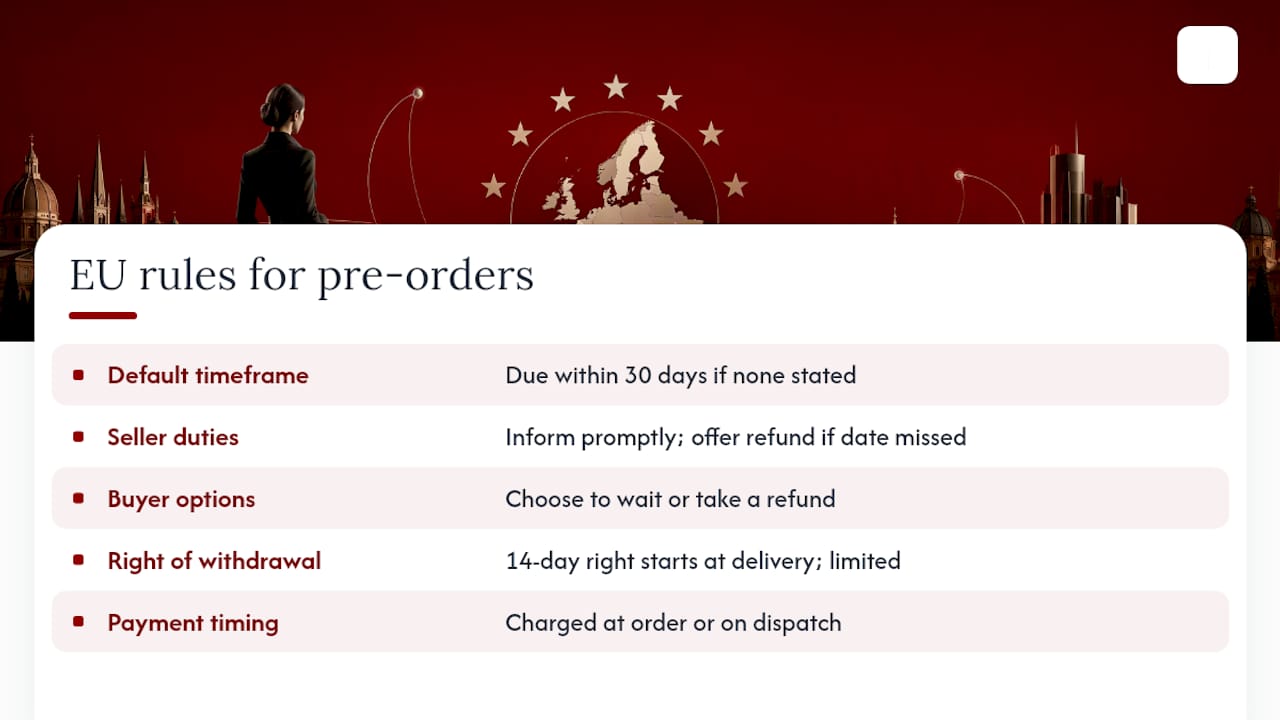
Under EU consumer rules, a seller must deliver within the timeframe stated at checkout, and if no timeframe is agreed, delivery is due within 30 days. That 30-day default rarely applies to genuine pre-orders, since sellers almost always quote their own availability window instead, but it becomes relevant the moment a seller gives no date at all.
Where a promised date is missed or significantly delayed, the merchant carries a clear obligation. Guidance for merchants running pre-orders states plainly that sellers must promptly inform customers and offer a refund when a release date cannot be met. The buyer decides whether to wait for the new date or walk away with their money back.
A delayed availability date is not, on its own, a breach that entitles you to cancel. A delayed availability date the seller fails to disclose or refuses to remedy is a different matter entirely, and one squarely in your favour.
Separately, the statutory 14-day right of withdrawal applies to most online purchases in the EU, but its clock typically starts from delivery, not from order placement, so it offers limited protection during a long pre-order wait itself.
On charging timing: some merchants charge the full amount at order placement, others only on dispatch. Whirlpool's pre-order terms are a useful example of transparent wording here, explicitly stating that pre-order stock is not yet in the warehouse, that dates are indicative, and that the customer will be contacted with a revised date if the original one cannot be honoured. If a seller charges you immediately and then delays for months, your leverage for a fast refund is stronger, not weaker, because you have already parted with the money.
Reading a seller's availability date correctly
Not every "availability date" means the same thing, and mistaking one type for another is where most disappointment starts.
- A single fixed date ("ships 14 April") is the strongest commitment and typically appears when stock is already staged or production is complete.
- A delivery window ("weeks 2 to 3 of March") signals genuine uncertainty the seller is managing honestly.
- An open-ended estimate ("ships when available," with no timeframe) offers you the least protection and the least information.
Merchant guidance on pre-order best practice is unambiguous on this point: precise windows measured in weeks, rather than vague seasonal language, measurably reduce cancellations and support disputes. Sellers who quote tight windows are usually managing their own supply chain closely enough to trust the number.
Statistic worth remembering: many merchants build a production buffer of roughly 10 to 25% on top of their expected lead time before quoting a date to customers. A seller quoting "8 weeks" has often privately targeted six or seven.
Red flags worth pausing over: no status page, no order number system, and language like "ships when available" with nothing more specific. A credible seller almost always publishes something firmer.
What to do the moment a pre-order is delayed
Delay does not mean disaster, but it does mean you should act rather than assume things will sort themselves out.
- Check your order status page or confirmation email first. Many sellers, including gaming and collectible retailers with dedicated status pages, post updates automatically before you need to ask.
- Contact the merchant directly, quoting your order number, the original estimated date, and your preferred remedy (new date, or refund).
- Ask for a firm revised date in writing. A vague "soon" is not an answer worth accepting.
- Request a refund if the new date is unacceptable, or if none is offered. Sellers are obliged to offer this when a promised date cannot be met.
- Escalate to your payment provider or a consumer protection body if the merchant is unresponsive for more than a reasonable period, typically 2 to 3 weeks after your initial contact.
- Refund timing depends on when you were charged: if payment was taken at order placement, expect the refund to follow standard card-processor timelines, usually 5 to 10 business days.
- If payment was only taken at dispatch and the item never shipped, there is nothing to refund. Confirm which model applies before assuming a refund is owed.
Buying a pre-order safely: what to check first
A little diligence before you click "confirm" spares most of the frustration later. Check that the availability date is specific rather than seasonal, that a returns and refund policy is stated clearly, and that the seller offers some form of order tracking or status page.
Pro Tip: Pay with a card that has a straightforward chargeback process, and if you are buying multiple items, place the pre-order separately from anything already in stock, so the in-stock pieces are not held hostage waiting for the pre-order to catch up.
- Confirm whether your card will be charged now or on dispatch, and set a reminder either way.
- Weigh whether the wait is worth it: for a genuinely limited or numbered piece, patience protects something scarce; for a mass-produced item you could buy elsewhere in stock, it usually is not.
What a trustworthy seller should tell you upfront
A merchant handling pre-orders responsibly publishes a short set of facts without you needing to ask. Look for a clearly stated estimated ship date, whether multi-item orders ship together or separately, when payment is actually taken, and how often status updates arrive.
- Estimated ship date, stated with a specific week rather than a season.
- Whether your order ships as one parcel or splits across availability.
- Payment timing: at order or at dispatch.
- A defined cadence for status updates, and a clear refund process if dates change.
Status pages and proactive updates do more than reduce complaints. They convert a buyer's patience into lasting trust, because uncertainty, not waiting itself, is usually what erodes goodwill. Jeeyodee applies the same principle to its own limited runs, publishing clear status communication rather than leaving collectors to guess.
How Jeeyodee treats a promise of time
We schedule every limited drop with a production buffer built in, never a date chosen to sound impressive. A garment finished in Italy, lined in Egyptian silk, and fitted with hand-aligned Italian cone studs is not assembled to a deadline invented for marketing. It is finished when the craftsmanship meets the standard we set, and we would rather tell a collector a longer, truthful window than a shorter, false one.

Every piece is numbered, produced once, and never repeated, which is precisely why we communicate status rather than leave clients to wonder. You can read more about the material choices behind each drop, including the 500 GSM cotton construction and the neoprene hood detailing, in our journal.
A transparent route to your next Jeeyodee piece
Jeeyodee runs its limited drops the way a serious buyer would want any pre-order handled: a defined release window, payment timing stated plainly at checkout, and status updates that arrive without you needing to ask.

Because every garment is individually numbered and never reproduced, the production schedule genuinely cannot be rushed, and we would rather hold a piece back a few extra days than release it before it meets the standard the number on the label implies. If the wait ever changes, you hear about it directly, with a clear remedy offered, not a vague apology. Refunds follow the same clarity: if a drop's timing shifts meaningfully, you are told and given the choice to wait or step back.
If a piece like this appeals to you, the current and forthcoming limited runs are listed on our maison landing page, where you can see what is available to reserve now.
Sources
FAQ
How does a pre-order actually work?
You reserve and often pay for an item before it exists in stock; the seller then produces or receives it, processes your order, and ships it once ready, with the total wait combining production time and standard shipping.
What is the maximum time a seller can take to deliver?
If no specific date is agreed, EU rules default to 30 days; most pre-orders instead quote their own longer window, which the seller must honour or explain.
What does "pre-order" mean on a platform like Temu?
It means the same as elsewhere: the item is not yet in the seller's warehouse, and the quoted date is an estimate rather than a guarantee, so treat any listed timeframe as indicative until dispatch confirmation arrives.
What happens after you pre-order a game?
Does Jeeyodee offer pre-orders on limited drops?
Yes, Jeeyodee occasionally opens limited pieces for pre-order with a defined release window and clear payment timing, always accompanied by direct status updates rather than an open-ended estimate.