TL;DR:
- Craftsmanship in fashion involves expert human skill and cultural knowledge that create permanent garments. It distinguishes luxury from mass production through slow, deliberate processes and high-quality finishes. Supporting artisans ensures cultural preservation, economic stability, and sustainable, ethical fashion practices.
Craftsmanship in fashion is defined as the application of expert human skill, meticulous attention to detail, and inherited cultural knowledge to the creation of garments that machines cannot replicate. A single haute couture piece can require over 2,000 hours of human labour. That figure is not an anomaly. It is the standard by which true artisanship in clothing design is measured, and it separates the atelier from the assembly line with absolute conviction. Artisan communities worldwide sustain this standard, from the embroidery houses of Paris to the hand-weaving workshops of Rajasthan, each one a living archive of technique and identity.
How does craftsmanship distinguish luxury fashion from mass production?
The role of craftsmanship in fashion is most visible in what it refuses to sacrifice: time, touch, and human judgement. Industrial manufacturing optimises for speed and uniformity. Craftsmanship does the opposite. It accepts irregularity as evidence of the hand, and treats each imperfection as a signature rather than a defect.

The physical demands of atelier work are rarely discussed. Expert artisans require months of training to master something as specific as wrist tension in embroidery, a skill built on real-time sensory feedback that no digital process can replicate. That knowledge lives in the body, not in a manual. It is transmitted through proximity, repetition, and trust between master and apprentice.
True fashion craftsmanship also shows in how a garment is finished internally. Authentic craftsmanship features integrated, structural finishing where embroidery moves fluidly with the fabric. Commercial shortcuts apply rigid, glued components that crack under wear. The difference is not aesthetic alone. It is structural, and it determines whether a garment lasts a season or a generation.
The contrast with fast fashion is not simply one of price. It is one of philosophy.
- Fast fashion treats the garment as a disposable object, produced in weeks and discarded in months.
- Handmade fashion treats the garment as a permanent object, worthy of care, repair, and inheritance.
- Craftsmanship introduces cultural heritage into the cloth itself, encoding the traditions of a specific community into every stitch.
- Artisanal production resists anonymity. You know where a hand-crafted piece was made, and often by whom.
Pro Tip: When assessing whether a garment is genuinely hand-crafted, examine the interior finishing. Machine-applied embellishments sit flat and rigid. Hand-worked details flex with the fabric and show subtle variation in spacing and tension.
What is the economic and social role of artisans in the global fashion industry?
The importance of craftsmanship in fashion extends far beyond aesthetics. It is an economic system. Hand weaving in India employs over 3 million workers, making it the country's second-largest employer after agriculture. That scale represents not a niche tradition but a functioning industrial alternative, one built on human skill rather than mechanised output.
Artisan micro-economies across Africa, the Caribbean, and Latin America preserve cultural authorship and local economic wealth through specialised production. These communities do not simply make goods. They maintain living knowledge systems that define regional identity and resist the homogenising force of global fast fashion. When a craft dies, it takes its cultural context with it.
"Artisanal production maintains cultural authorship and resists fast fashion's anonymous industrialisation, preserving economic dignity for local communities. Buying handmade is one of the most political acts available to a fashion consumer."
The social contract between consumer and artisan carries real weight. Four principles define what genuine support for artisan communities requires:
- Fair wages. Artisans must receive payment that reflects the time and skill invested, not a price compressed to compete with factory output.
- Equitable value distribution. The margin between what an artisan earns and what a consumer pays must be transparent and defensible.
- Formal recognition. Skilled craft workers deserve professional standing, not the romanticised but precarious status of "traditional craftsperson."
- Succession investment. Communities and brands must fund apprenticeships and training to ensure techniques survive beyond their current practitioners.
Consumers who purchase artisan-made fashion are not simply buying a product. They are participating in an economy that sustains livelihoods, preserves knowledge, and resists cultural erasure.
How does craftsmanship support sustainable and ethical fashion practices?
Sustainable fashion craftsmanship rests on a principle that fast fashion structurally cannot adopt: slow production. Slow production uses fewer resources, generates less waste, and creates garments designed to last. The environmental case for craftsmanship is inseparable from the human one.
True sustainability in fashion requires liveability and dignity for artisans, including fair wages and equitable value distribution, not merely a romanticised heritage narrative. A garment made from organic cotton by an underpaid artisan is not a sustainable product. Sustainability is a whole system, and the human element is its most frequently ignored component.
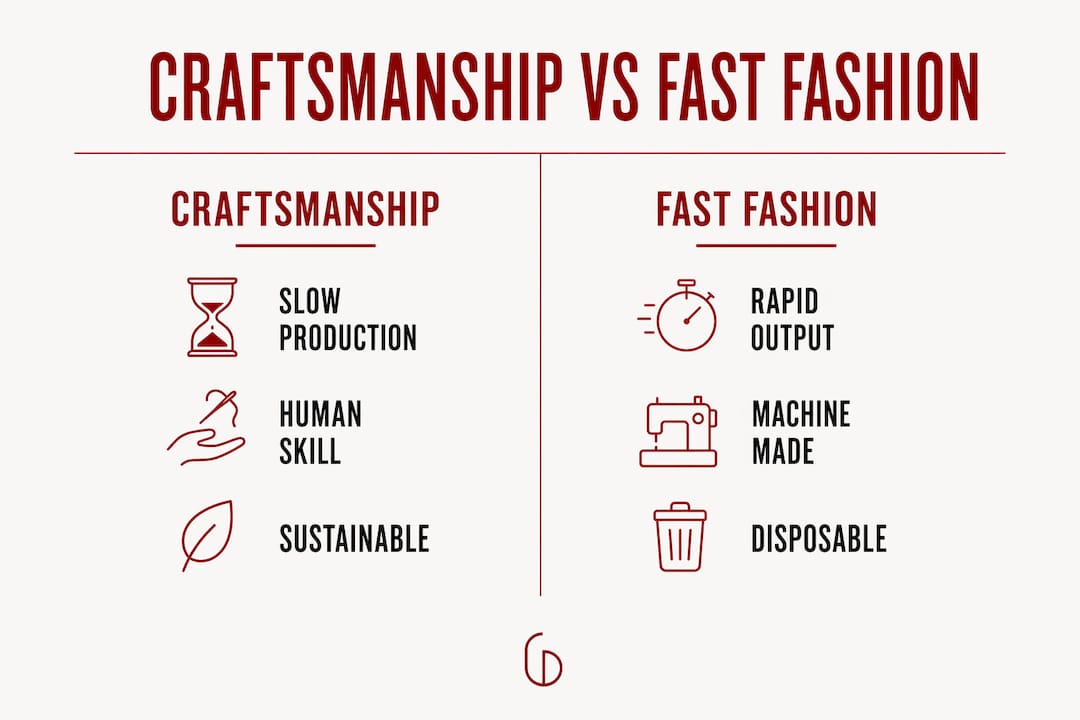
| Dimension | Craftsmanship approach | Fast fashion approach |
|---|---|---|
| Production speed | Slow, deliberate, and skill-led | Rapid, mechanised, and volume-driven |
| Material use | Natural, considered, and often locally sourced | Synthetic, high-volume, and globally sourced |
| Labour conditions | Skilled, often community-based, and relationship-led | Anonymous, frequently precarious, and cost-compressed |
| Product lifespan | Designed for longevity and repair | Designed for seasonal replacement |
| Cultural value | Encodes heritage and identity | Culturally neutral and trend-dependent |
The sustainability paradox is real. Many brands use the language of craft and heritage to command premium prices while the artisans producing their goods remain economically vulnerable. Consumers who recognise and pay a fair price reflecting artisans' liveability are the ones genuinely supporting ethical fashion, not simply those who buy "handmade" labels.
Pro Tip: Before purchasing a garment marketed as artisan-made, ask the brand directly whether it publishes its artisan wage data. Transparency on this point separates genuine ethical producers from those using craft as a marketing device.
What challenges threaten the future of craftsmanship in fashion?
The most serious threat to fashion craftsmanship is not fast fashion. It is silence. Craftsmanship techniques depend on undocumented, person-to-person transmission, and without formal succession planning or apprenticeships, centuries of accumulated skill face extinction. When a master artisan retires without a trained successor, the knowledge they carry does not transfer to a file or a database. It disappears.
The response from within the industry has been uneven but notable. Chanel's le19M hub in Paris hosts 11 specialised houses and nearly 700 artisans, centralising traditional French crafts under one roof and providing stable employment alongside structured training. That model treats craft preservation as an institutional responsibility, not a charitable gesture.
Designers are also adapting tradition rather than simply archiving it. Divya Sheth revives the traditional gota patti craft by integrating sacred motifs with slow, hand-folded detailing that restores the fluidity and structure lost in mass-produced embroidery. Her approach demonstrates that craftsmanship evolves as an active process. Techniques survive by adapting into contemporary design, not by remaining museum pieces.
| Challenge | Current response | Outcome if unaddressed |
|---|---|---|
| Undocumented skill transmission | Apprenticeship programmes and atelier schools | Permanent loss of irreplaceable techniques |
| Artisan economic precarity | Fair-trade certification and wage transparency campaigns | Craft communities abandoned for factory work |
| Commercialised shortcuts | Designer-led craft revival and quality authentication | Degraded standards passed off as genuine craftsmanship |
| Ageing practitioner base | Institutional hubs like le19M centralising artisans | Generational knowledge gap with no succession |
The commercialisation risk is equally serious. As craft aesthetics become fashionable, brands adopt the visual language of handmade production without the substance. Machine-made items are marketed with artisanal imagery. The result is a dilution of what craftsmanship trends in fashion actually mean, and a consumer base that cannot distinguish the genuine from the imitation.
Key takeaways
Craftsmanship in fashion is the irreplaceable combination of human skill, cultural knowledge, and slow production that defines genuine luxury and sustains artisan economies worldwide.
| Point | Details |
|---|---|
| Craftsmanship defines luxury | A single couture piece can require over 2,000 hours of labour, a standard no industrial process matches. |
| Artisans sustain economies | India's hand-weaving sector alone employs over 3 million workers, functioning as a full economic alternative to factory production. |
| Sustainability requires fair pay | Ethical fashion means paying artisans a liveable wage, not simply choosing organic materials or heritage branding. |
| Skill transmission is fragile | Undocumented, person-to-person knowledge transfer means craft techniques face extinction without formal apprenticeships. |
| Adaptation preserves tradition | Designers who integrate heritage techniques into contemporary work keep craftsmanship alive as a living discipline. |
Why craftsmanship remains the only honest luxury
We have watched the fashion industry accelerate for decades, and the acceleration has not produced better clothes. It has produced more of them. The distinction matters enormously.
As AI-generated aesthetics rise, the human trace in a handmade garment becomes the primary differentiator that luxury consumers value. That is not sentiment. It is a market reality, and it confirms what we at Jeeyodee have held as conviction from the beginning: the hand cannot be replaced, only imitated.
What troubles us is the ease with which "craftsmanship" has become a marketing term rather than a measurable standard. A garment is either hand-finished or it is not. The wrist tension of an embroiderer either lives in the cloth or it does not. There is no middle ground, and the consumer who cannot see that difference is the one most easily deceived.
The artisans who carry these skills are not heritage attractions. They are working professionals whose knowledge represents centuries of accumulated intelligence. We owe them fair payment, formal recognition, and the institutional investment that ensures their craft outlives them. Anything less is extraction dressed as appreciation.
At Jeeyodee, every piece we produce is a permanent chapter. It is made once, numbered, and never repeated. That discipline is not a marketing strategy. It is a commitment to the idea that a garment worthy of your attention deserves the full weight of human skill behind it.
— Jeeyodee
Jeeyodee: numbered luxury, made slowly

Jeeyodee operates as an independent luxury maison with a single governing principle: nothing is repeated. Every piece in the collection is handcrafted in Italy, individually numbered, and produced in a strictly limited run that closes permanently once it sells. The materials reflect that conviction. Egyptian silk hood linings, meticulous Italian cone studs, and heavyweight cotton are not decorative choices. They are the physical expression of a philosophy that treats each garment as a collectible object rather than a seasonal product.
The symbolism behind each design carries equal weight to the construction. Pieces like the hand-finished Thorns variants encode meaning into their form, making ownership an act of alignment with the values they represent. Explore the full range at jeeyodee.store and find the piece that belongs to you permanently.
FAQ
What does craftsmanship mean in fashion?
Craftsmanship in fashion refers to the application of expert human skill, cultural knowledge, and meticulous hand-finishing to garment production. It prioritises quality and permanence over speed and volume.
How does craftsmanship differ from fast fashion production?
Craftsmanship relies on slow, skill-led production using natural materials and trained artisans, while fast fashion uses mechanised, high-volume manufacturing designed for rapid turnover and low cost.
Why is the role of artisans in fashion important economically?
Artisan production sustains entire communities. India's hand-weaving sector alone employs over 3 million workers, and artisan micro-economies across Africa, Latin America, and the Caribbean preserve both cultural identity and local economic wealth.
Is handmade fashion genuinely more sustainable?
Handmade fashion is more sustainable when artisans receive fair, liveable wages and production volumes remain low. Sustainability fails when craft aesthetics are used to justify premium pricing while artisan pay remains exploitative.
How can consumers support genuine craftsmanship in fashion?
Consumers support genuine craftsmanship by purchasing from brands that publish wage data, produce in limited quantities, and invest in artisan training. Asking direct questions about production conditions is the most reliable test of a brand's commitment.