Handmade clothing reduces emissions through fewer, quieter mechanisms than most sustainability marketing admits: lower industrial energy and water use at the production stage, fewer freight legs between fibre and wardrobe, and a longer useful life per garment that spreads its footprint across hundreds more wears. Fashion already accounts for roughly 8 to 10% of global greenhouse gas emissions, alongside tens of millions of tonnes of textile waste each year. That scale makes the mechanism behind each garment worth scrutiny, not just its label.
The reductions come from specific, traceable choices:
- Hand-processing and small-batch dyeing that avoid the energy intensity of industrial mills
- Regional ateliers that shorten the freight chain between raw material and finished piece
- Natural fibres that shed no plastic microfibres into water systems
- Garments designed to be repaired and worn for years, not seasons
We will walk through each mechanism, where the evidence is strongest, where it is thinner, and how a maison such as Jeeyodee applies the principle in practice.
Key Takeaways
Handmade clothing lowers emissions primarily through reduced industrial energy and water use, shorter freight chains, and longer garment life measured per wear rather than per purchase.
| Point | Details |
|---|---|
| Per-wear framing beats per-unit | A garment's true footprint divides by its total wears, not just its manufacturing cost, so durability matters as much as material. |
| Design sets 80% of impact | The EU's own analysis finds most of a garment's lifecycle footprint is fixed at the design stage, before production begins. |
| Natural fibres avoid microplastic shedding | Synthetics release microfibres into waterways with every wash; natural and regenerative fibres do not carry this specific pollution risk. |
| Reuse only helps if it displaces new buying | Repair and longevity reduce emissions only when they replace a future purchase, not when they simply add to a wardrobe. |
| Jeeyodee builds against overproduction | Limited, one-off drops made in Italian ateliers from heavyweight cotton and silk-lined constructions aim to reduce unsold stock and encourage long-term ownership. |
Table of Contents
- How production methods change energy and water use
- Why quality, repair and longevity lower per-wear emissions
- Small-batch ateliers, freight, and who you can actually trust
- Materials, microplastics and how dye choices change the outcome
- Where handmade falls short, and what closes the gap
- How Jeeyodee's craft choices map to lower emissions
- Comparing carbon footprints: handmade against mass-produced
- What artisan skill actually contributes to lower emissions
- Case studies: brands proving the mechanism works
- What the evidence actually supports, and what it does not
- A collectible piece made once for someone who intends to keep it
- Sources
- FAQ
How production methods change energy and water use
The gap between handmade and industrial clothing opens earliest, at the fibre and fabric stage. Mechanised mills run at scale, which lowers cost per metre but raises absolute energy draw across spinning, weaving, and finishing. Hand-processing methods, by contrast, often skip several of the most energy-hungry steps entirely.
Traditional hand-spun and hand-woven fabrics such as Khadi illustrate this starkly. Case studies comparing Khadi to mechanised mill fabric found it can be produced with substantially less grid electricity and water use per metre than its industrial equivalent. The comparison will not hold for every hand-process everywhere. A small workshop still running on a fossil-fuel-heavy local grid gains little from skipping mechanisation. But where the hand method is authentic and the energy source is clean, the difference is not marginal.
The mechanisms that matter most:
- Fibre processing done by hand avoids the continuous power draw of industrial carding and combing lines
- Hand-spinning and hand-weaving use human effort rather than electric looms running around the clock
- Small-batch dyeing allows precise dye-to-water ratios, cutting the volume of water discharged compared with bulk-vat industrial dyeing
- Finishing steps such as pressing and hand-stitching replace chemical-heavy industrial treatments used to standardise mass-market fabric
Waste reduction follows a similar logic. Pattern efficiency, the careful nesting of pattern pieces to minimise offcuts, is second nature in small-batch cutting, where a single garment's fabric is planned rather than run through automated cutters optimised for volume, not yield. Offcuts and remnants get repurposed into linings, pocket bags, or trim rather than swept into landfill streams. None of this eliminates emissions outright. It shifts the balance of where energy and water go, and by how much, at the exact stage where fashion's footprint is heaviest.
Why quality, repair and longevity lower per-wear emissions
A garment's true environmental cost is not what it takes to make. It is that cost divided by every wear the piece survives. This is the per-wear metric, and it changes the entire calculation in favour of durability over volume.
The European Commission's own lifecycle analysis puts a striking figure on this: roughly 80% of a product's environmental footprint is set at the design stage, before a single stitch is sewn. A garment designed for five wears and a garment designed for five hundred wears can leave nearly the same manufacturing footprint, yet the second amortises that cost across a hundred times more use. Design, not material alone, decides the outcome.
Handmade and limited-edition pieces tend to perform better on this metric for reasons that are as much psychological as physical:
- Reinforced seams and quality construction extend physical lifespan beyond typical fast-fashion garments
- A piece that is individually numbered or one-of-one tends to be worn with more care and kept longer
- Repairability matters more where a garment feels irreplaceable rather than disposable
- Emotional attachment to a unique object slows the replacement cycle that drives repeat manufacturing
Pro Tip: Before buying anything new, ask whether the garment can be repaired by the maker. A piece with no repair path is a piece with a shorter life, whatever its material claims.
The caveat matters as much as the claim. Reuse and durability only reduce emissions if they actually displace new purchases rather than simply adding to a wardrobe. Modelling of the second-hand clothing market shows that rebound effects and incomplete substitution can erase the expected gains when people buy a "sustainable" piece and keep shopping exactly as before. Longevity only works as an emissions lever when it replaces consumption, not when it sits alongside it.
Small-batch ateliers, freight, and who you can actually trust
Distance costs carbon, and small-batch production tends to travel less of it. A regional atelier producing limited runs for a known customer base skips the long, multi-leg freight chains that move mass-market stock between continents before it reaches a shop floor, and it avoids the emissions cost of unsold inventory shipped back or destroyed.
The freight advantage is only part of the story. Small runs also make oversight possible in a way volume production rarely allows.
- Shorter supply chains mean fewer transhipment points, each one adding fuel-burning transport and handling emissions
- Producing to near-exact demand, rather than forecasted volume, avoids the returns and unsold stock that plague fast fashion
- A workshop working with a handful of dye houses can audit water treatment and chemical inputs directly, something near impossible across a diffuse global supplier network
- Direct relationships with fibre suppliers make regenerative and traceable sourcing verifiable rather than assumed
None of this is automatic. A small atelier importing high-impact synthetic fibres from distant, opaque suppliers gains little from a short final assembly leg. The advantage only holds when small-batch production is paired with equally careful material sourcing, not treated as a virtue on its own. Craft economies also carry a social dimension worth naming directly: they sustain traditional weaving and hand-production skills that industrial scale has been steadily displacing, though those trades depend on real investment and training to survive, not nostalgia. For readers who want the fuller argument behind small-batch sustainability, our piece on slow fashion principles sets out the reasoning in more depth.
Materials, microplastics and how dye choices change the outcome
Fibre choice is where the emissions story meets a pollution story most shoppers never see. Every wash of a polyester or synthetic-blend garment releases microfibres into wastewater, and those fibres do not biodegrade. Scientific reporting on the fast-fashion backlash notes that washing synthetics is now understood as a major and growing source of microplastic pollution entering rivers and oceans, at a scale that dwarfs most people's assumptions about where ocean plastic actually comes from.
Natural and regenerative fibres avoid this specific harm entirely. Hemp, linen, organic cotton, and heavyweight cotton constructions shed no plastic microfibres, whatever else their footprint involves. That distinction, natural fibre versus synthetic, matters more for water pollution than almost any other single material decision a maker or buyer can make.
What to ask before you buy:
- Is the fibre natural, regenerative, or a synthetic blend, and what happens to it at end of life?
- Is dyeing done with botanical or low-impact dyes and closed water loops, or bulk industrial vats?
- Does the maker disclose which dye house or mill they use, or is sourcing left vague?
- Can the garment biodegrade, or will it persist in landfill for decades?
Regenerative fashion scholarship frames this as a systemic question rather than a checklist. The goal, according to recent academic work on regenerative circularity, is materials that can safely return to natural systems and design that actively restores rather than merely reduces damage. A well-made natural-fibre garment, dyed responsibly and built to last, edges closer to that standard than almost anything mass-produced can.
Where handmade falls short, and what closes the gap
Craft is not a guarantee. A handmade garment cut from imported, high-impact synthetic fabric, sewn in a workshop running on a coal-heavy grid, can carry a heavier footprint than a well-designed mass-market piece made from recycled natural fibre. The label "handmade" describes a process, not automatically a result.
Two honest limits deserve naming:
- Small-scale production powered by inefficient or fossil-heavy energy sources can lose the advantage that hand-processing usually offers
- Reuse, repair, and longevity only reduce net emissions if they genuinely displace new purchases; the same modelling that supports the per-wear argument warns that incomplete substitution and rebound effects can quietly cancel the gain
What closes the gap is largely structural. The EU's forthcoming rules on design-for-durability, repairability, and extended producer responsibility push the entire market, handmade and industrial alike, towards garments built to be kept and mended rather than discarded. Craft gets the credit for durability. Policy is what makes durability the default rather than the exception.
How Jeeyodee's craft choices map to lower emissions
Jeeyodee's practice was built around the same mechanisms this article has traced, not as marketing language but as production discipline. Every piece is made once, numbered, and never repeated. That single decision removes the overproduction and unsold-stock problem entirely, because nothing is manufactured against a forecast.
- Limited, one-off drops mean no surplus inventory, no discounting, and no destroyed stock
- Production in Italian ateliers keeps the freight chain short between maker and finished piece
- Heavyweight cotton construction and Egyptian silk hood linings are chosen for how they age, not just how they photograph
- Individually numbered garments encourage the kind of care that extends a piece's working life by years
Pro Tip: A garment worth keeping is one you were told the story of before you bought it. Ask what a piece is made from and why, not just what it costs.
Readers curious about why this approach costs more than mass production, and what that premium actually pays for, will find the full reasoning in our piece on why handcrafted clothing costs more.
Comparing carbon footprints: handmade against mass-produced
Direct, garment-for-garment carbon comparisons are difficult to standardise because mass production and handmade craft measure impact across different scales. Mass production spreads emissions across enormous volumes, which lowers the marketing-friendly "per unit" figure even as absolute output, and absolute harm, climbs. A factory producing fifty thousand identical hoodies a season will show a lean per-piece energy figure on paper, but the volume itself, plus unsold stock, discounting cycles, and rapid replacement, drives the real damage.
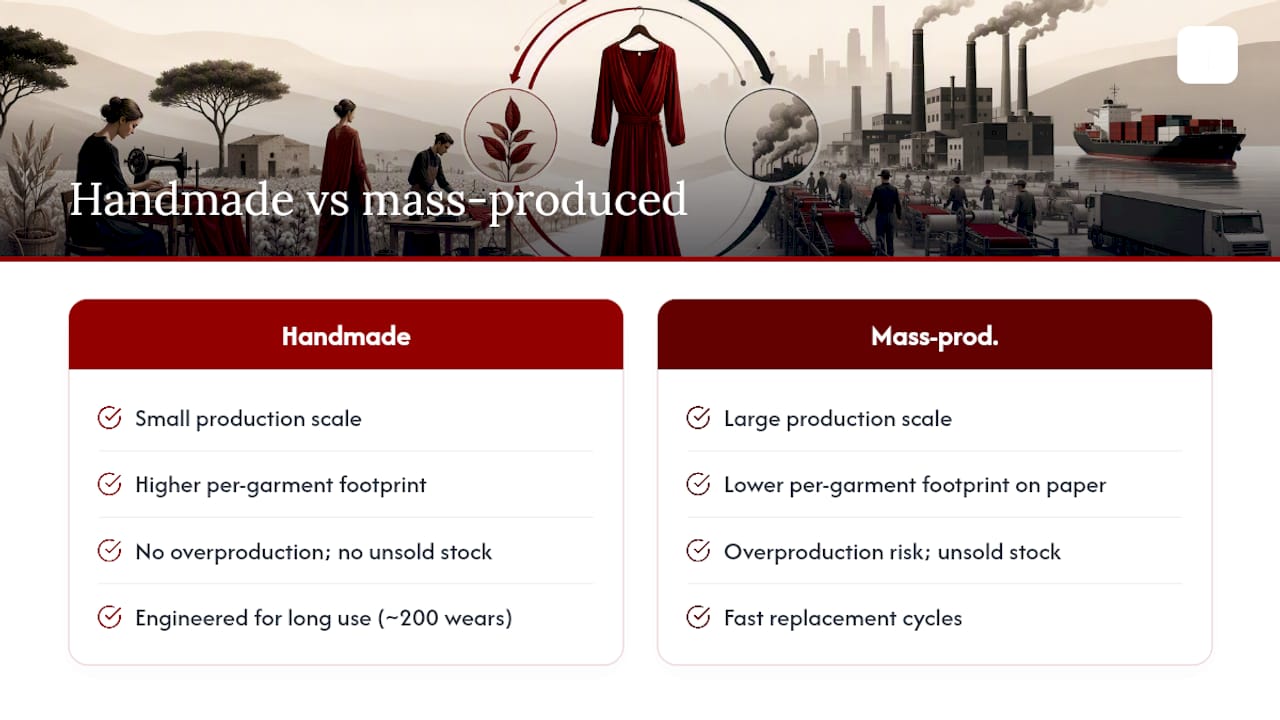
Handmade production inverts that logic. Per-piece energy and water use can run higher for a single garment made by hand than for one pulled off an industrial line, particularly where mechanised finishing outperforms manual methods on pure efficiency. What handmade production removes is the volume problem itself: no overproduction, no unsold runs destined for landfill or incineration, and a garment engineered to be worn for years rather than one season.
The fairest comparison, then, is not per garment but per wear, over the piece's full working life. A mass-produced piece worn eight times before discarding carries a materially worse per-wear footprint than a handmade piece worn two hundred times, even if its initial manufacturing footprint looked smaller on a spreadsheet. That reframing, from per-unit to per-wear, is the single most useful lens for judging any garment's real environmental cost.
What artisan skill actually contributes to lower emissions
Artisan technique is not a romantic flourish. It is a set of practical skills that directly reduce material waste and energy demand in ways automated production cannot easily replicate.
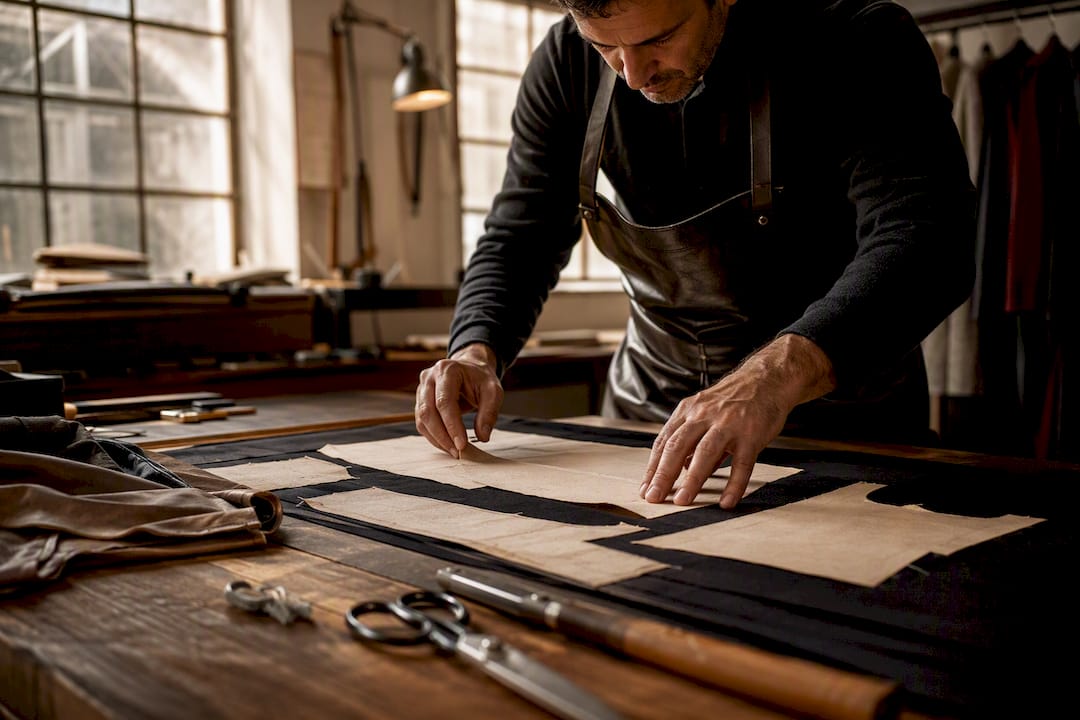
A skilled cutter reading a bolt of fabric by hand can nest pattern pieces to minimise offcuts in a way that generic automated cutting, optimised for speed across thousands of identical pieces, rarely matches on a single, unique garment. Hand-finishing techniques such as felled seams and reinforced stitching extend a garment's structural life well beyond machine-finished equivalents, which lowers replacement frequency and, by extension, the emissions tied to manufacturing a successor garment.
Traditional dyeing and hand-processing techniques, where genuinely practised, also tend to use less water per unit of output than industrial vat dyeing, because the process is controlled by feel and by eye rather than run at continuous industrial volume. This is precisely the workmanship that trade analyses of craft economies describe as sustaining livelihoods and traditional skills that would otherwise disappear under industrial consolidation, skills that, once lost across a generation of artisans, are extraordinarily difficult to recover. The emissions case for artisan technique, in other words, sits alongside a cultural one: both depend on keeping these skills economically viable rather than treating them as heritage curiosities.
Case studies: brands proving the mechanism works
The clearest evidence for handmade production's emissions advantage comes from direct fabric comparisons rather than brand marketing claims. Khadi, the traditional hand-spun and hand-woven cotton fabric associated with Indian craft production, offers one of the most documented examples: case studies comparing it to mechanised mill cloth show near-zero grid electricity use and substantially lower water consumption per metre, because the entire spinning and weaving process happens without industrial machinery.
That case matters beyond its specific fabric. It demonstrates the mechanism in its purest form: removing electrified, high-volume machinery from the production chain removes the energy draw that machinery would otherwise require, without any change to the fibre itself. The same logic applies, in smaller and less dramatic ways, to any workshop that hand-cuts, hand-dyes in small batches, or hand-finishes rather than running garments through fully automated lines.
Practical atelier-level measures reinforce the pattern: pattern-efficient cutting that minimises fabric waste, small-batch dyeing using low-impact dyes with closed-loop water systems, and building repair or resale pathways directly into the customer relationship rather than treating them as an afterthought. None of these measures depends on scale. They depend on attention, which is precisely what small-batch and handmade production structurally provides more room for than volume manufacturing ever can.
What the evidence actually supports, and what it does not
The conventional wisdom treats "handmade" as a virtue in itself. It is not. The evidence supports something narrower and more useful: specific mechanisms, lower energy at the production stage, shorter freight, natural fibres, and genuine longevity, reduce emissions, and handmade production happens to make several of those mechanisms easier to achieve consistently. That is a meaningful distinction, not a technicality.
What gets underestimated is how much of the outcome depends on design intent rather than the maker's hands alone. A beautifully sewn garment in the wrong fibre, sourced without transparency, still carries a heavy footprint. What we would ask readers to prioritise first is not craft for its own sake, but the question craft usually forces into the open: what is this made from, how far did it travel, and will you still be wearing it in five years? Answer that honestly, and the emissions case tends to follow.
A collectible piece made once for someone who intends to keep it
If the mechanisms above tell you anything practical, it is this: the most sustainable garment in your wardrobe is the one you never need to replace. Jeeyodee exists for exactly that reader, someone who would rather own one piece with a number and a story than several with neither.

Each Jeeyodee piece is produced once, in an Italian atelier, from heavyweight cotton finished with an Egyptian silk hood lining and meticulously aligned Italian cone studs. Nothing is restocked. Nothing is reproduced. The numbering on the garment is not decoration, it is a record, proof that this exact piece exists nowhere else and never will again. That singularity is the opposite of the overproduction cycle driving fashion's emissions problem, and it is precisely why the maison's approach rewards the reader who wants fewer, better, permanent things rather than more of anything.
Bespoke atelier commissions are available for those who want a piece built entirely around their own specification, secured with a 50% deposit ahead of final pricing agreed directly with the maison. For those ready to own a numbered piece from the current drop, visit Jeeyodee to see what remains before it is gone for good.
Sources
- Regenerative Fashion Systems: Redefining Circularity in the Fashion and Textiles Industry (Springer Nature)
- Modeling conditions that shape sustainability outcomes in the second-hand clothing market (IOPscience)
- The fashion industry faces a critical sustainability crisis (MDPI Sustainability)
FAQ
What is the 3-3-3 rule for clothes?
The 3-3-3 rule is a wardrobe-editing method where you wear three key pieces for three months in three main colours, designed to test how much you actually rely on fewer garments. It is unrelated to emissions data directly, but it reflects the same per-wear logic this article covers: fewer, better pieces worn more often lower your overall footprint.
Is Zara ethical now?
Fast-fashion retailers, including large mass-market chains, have introduced recycling and material initiatives in recent years, but the underlying volume-driven business model remains the primary driver of the sector's 8 to 10% share of global emissions. A retailer can improve individual practices while the model itself still relies on high turnover and overproduction.
Is 100% cotton bad for the environment?
Conventional cotton farming can be water and pesticide intensive, but cotton itself sheds no plastic microfibres and is biodegradable, unlike synthetic blends. The environmental outcome depends heavily on how it is farmed, dyed, and how long the finished garment is actually worn.
What fabrics are 100% biodegradable?
Natural fibres such as organic cotton, linen, hemp, and wool are biodegradable, breaking down without leaving persistent plastic residue. Synthetic fibres such as polyester and nylon are not, and they are the primary source of microplastic shedding during washing.
Does buying from a small maison like Jeeyodee actually reduce emissions?
It can, through the specific mechanisms this article details: no overproduction from one-off numbered drops, shorter freight from Italian atelier production, and garments built from heavyweight cotton and silk linings designed to last years rather than seasons. The advantage depends on the piece genuinely displacing future purchases rather than simply adding to a wardrobe.