
TL;DR:
- For luxury collectors, clean aesthetic fashion emphasizes timeless garments with superior construction and provenance over brand logos. Such pieces are individually numbered, artisanally made, and designed to age with authority, reflecting true rarity and craftsmanship. Proper assessment involves inspecting interior finishing, unique edition markings, and high-quality materials to ensure lasting value.
For a luxury collector, clean aesthetic fashion is not a trend. It is a discipline: the deliberate assembly of timeless, foundational garments where construction and provenance carry more weight than any logo. The philosophy, which stylists describe as "simplicity as the ultimate sophistication," finds its highest expression in limited-edition, artisanally made pieces that age with authority.
The elemental signals a collector should seek:
- Timeless silhouette — proportions that read correctly across decades, not seasons
- Premium fabric — heavyweight cotton, high-twist wool, fine-gauge cashmere, Egyptian silk
- Discreet artisan details — hand-finished edges, precisely aligned hardware, interior lining quality
- Individual numbering and provenance — edition certificates, atelier receipts, construction photography
Maison Jeeyodee embodies this ethos precisely. Every piece is produced once, individually numbered, and never repeated, making each garment a permanent chapter rather than a seasonal purchase.
Table of Contents
- What separates collector-grade minimalism from mass-market simplicity
- Capsule wardrobe essentials every collector should prioritise
- Materials and construction signals that justify collectible value
- Accessories that complete the look without diluting it
- How to style the clean aesthetic with contemporary restraint
- Buying and collecting limited-edition garments in the UK
- Care, storage and provenance documentation
- How to assess a limited-edition garment before you acquire it
- Sustainability and ethical considerations in luxury clean aesthetic fashion
- Designers and maisons pioneering the clean aesthetic in luxury fashion
- Investment potential and resale market trends for clean aesthetic luxury garments
- How to build and evolve a clean aesthetic collection over time
- Key takeaways
- Why limited-edition production is the only honest form of the clean aesthetic
- Maison Jeeyodee: acquiring a numbered piece or commissioning a bespoke garment
- Useful sources and further reading
- FAQ
What separates collector-grade minimalism from mass-market simplicity
The clean aesthetic, at its most considered, is an ethic of restraint rather than a visual style. Social media amplified the term, but the underlying philosophy has always appealed to collectors who understand that longevity and construction are the true markers of value.
Mass-market minimalism mimics the surface: neutral palette, spare silhouette, little decoration. Collector-grade simplicity goes further. It asks whether the garment was made with conviction, whether the interior finishing reflects the same care as the exterior, and whether the edition is genuinely limited or merely marketed as such.
Pro Tip: When assessing a piece for your collection, turn it inside out before you consider the outside. Inspect seam allowances, lining attachment, and whether the interior fabric has been finished or left raw. A garment that is as considered inside as out is built to last and to hold value.
The distinction matters because internal finishing and lining quality are predictive of both durability and resale confidence. Hollow minimalism offers a clean surface over a compromised structure. True maison-standard simplicity offers both.
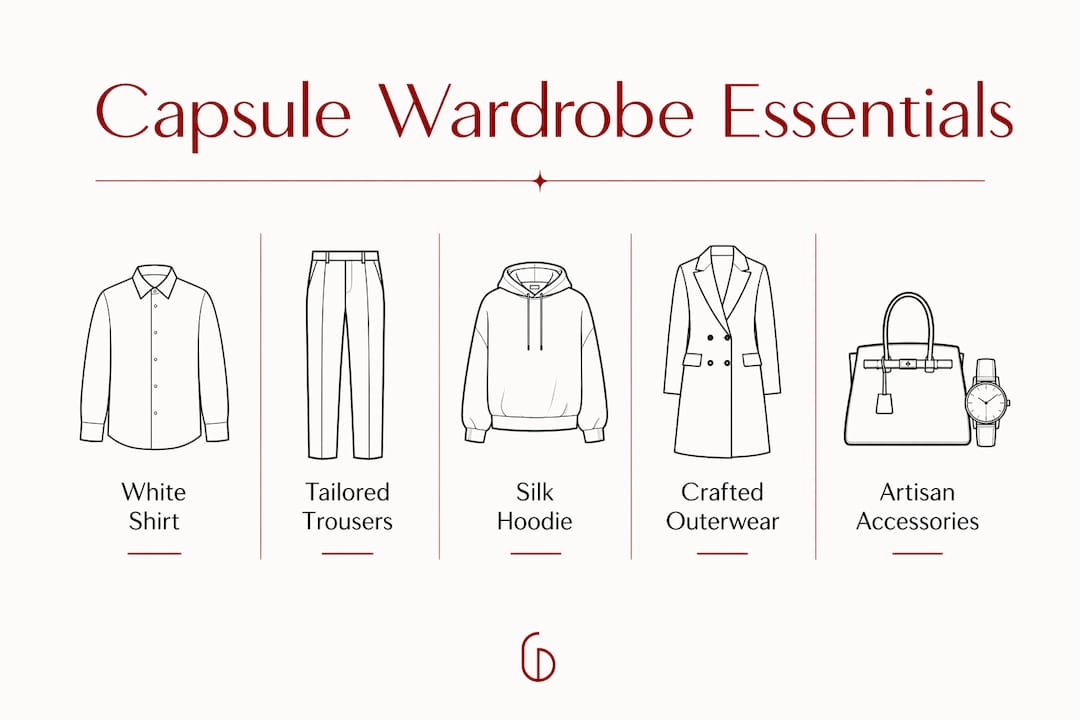
Capsule wardrobe essentials every collector should prioritise
A capsule-led approach prioritises quality over quantity. For a collector, each piece must justify its place not only aesthetically but as a provenance-bearing object.
- Crisp white button-down — the foundational garment; assess collar construction and placket stitching
- Tailored trousers — precise break, clean seam lines, quality waistband interfacing
- Structured blazer — canvas or half-canvas construction; check lapel roll and shoulder padding
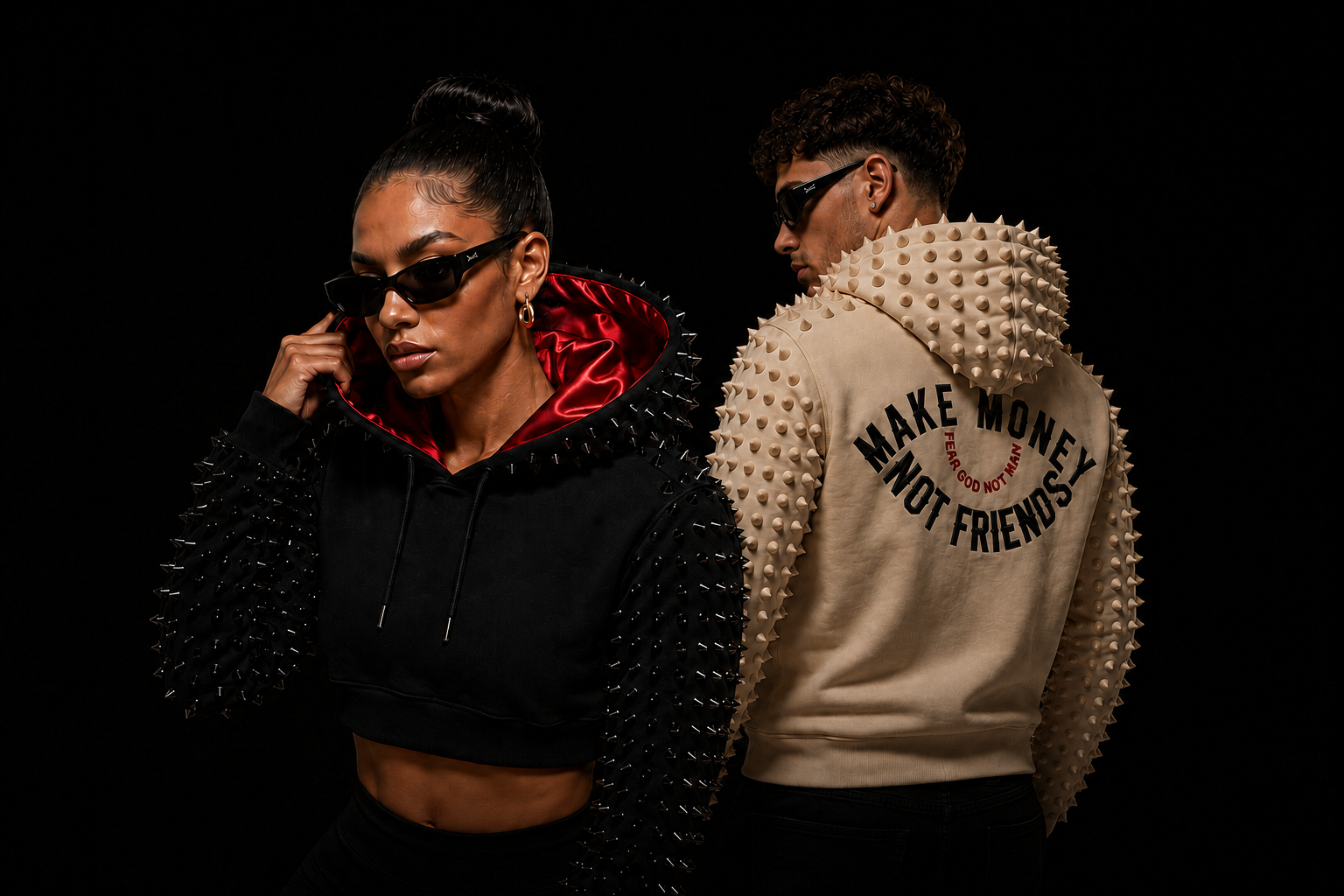
- Heavyweight cotton hoodie with silk lining — the contemporary collectible; Maison Jeeyodee's Thorns variants, with Egyptian silk hood linings and individually aligned Italian cone studs, set the standard here
- Refined knitwear — fine-gauge cashmere or merino; assess stitch density and seam finishing
- Classic outerwear — wool or wool-blend; check pattern matching at seams and lining attachment
For polished capsule building, each garment should serve multiple contexts without alteration.
| Garment type | Raison d'être | Artisanal signals to check |
|---|---|---|
| White button-down | Foundational versatility | Collar construction, placket stitching, fabric weight |
| Tailored trousers | Structural anchor | Seam precision, waistband interfacing, break |
| Heavyweight hoodie | Contemporary collectible | Lining quality, hardware alignment, edition numbering |
| Refined knitwear | Textural authority | Stitch density, seam finishing, fibre provenance |
| Classic outerwear | Seasonal permanence | Pattern matching, lining attachment, button quality |
Materials and construction signals that justify collectible value
Fabric weight and stitch density create tactile authority that no photograph can replicate. For a collector, these are the primary signals.
Materials to prioritise:
- Heavyweight cotton (300gsm and above for outerwear-weight pieces)
- Egyptian silk linings — the interior of a Jeeyodee Thorns hoodie carries this as standard
- High-twist wool for suiting and outerwear
- Fine-gauge cashmere (16-gauge and finer) for knitwear
- Vegetable-tanned leather for accessories and hardware backing
Construction signals:
- Aligned Italian cone studs — each one set by hand, verified by eye
- Reinforced seams at stress points (underarm, crotch, pocket mouth)
- Hand-finished edges on linings and facings
- Pattern matching at side seams and hems
- Bespoke hardware with consistent finish across the garment
For deeper technical context on luxury fabric performance, the grade of fibre and its twist count directly affect how a garment drapes, recovers, and ages.
Pro Tip: Request construction photographs before acquiring any limited-edition piece remotely. A maison confident in its work will provide close-up imagery of seam finishing, lining attachment, and hardware alignment. Reluctance to share these is itself a signal.
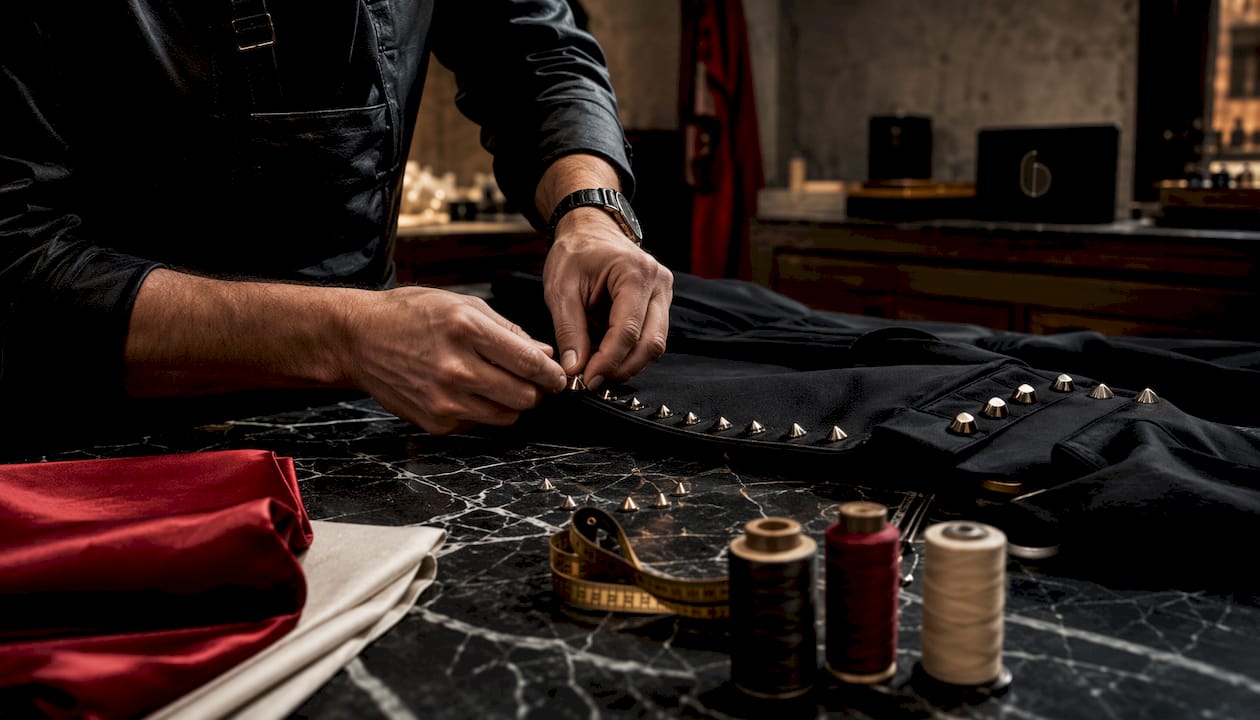
The Jeeyodee craftsmanship guide details precisely how each of these signals is verified before a numbered piece leaves the atelier.
Accessories that complete the look without diluting it
Delicate gold jewellery, structured bags, and artisanal footwear are the canonical accessories of the clean aesthetic. For a collector, each piece should carry its own provenance.
- Delicate gold jewellery — thin chains, small hoops; look for hallmarks and hand-finishing at clasps
- Structured handbags — clean geometry, quality hardware, interior lining that matches the exterior ambition
- Minimalist eyewear — acetate or titanium; assess hinge quality and lens optical clarity
- Classic shoes — leather-soled, Goodyear-welted where possible; check stitching uniformity
Scale and restraint matter as much as quality. A single artisan detail, a bespoke clasp, a hand-stitched edge, can transform a simple garment into a collectible moment. The principle is one focal point per look, not an accumulation of signals competing for attention.
Pro Tip: When a garment carries significant artisan detail, such as individually set hardware, let the accessories recede. A plain gold band and a structured bag in a tonal shade are sufficient. The garment earns the attention; the accessories confirm the collector's discipline.
How to style the clean aesthetic with contemporary restraint
Styling a limited-edition piece well protects both its visual integrity and its long-term value. The approach is compositional, not decorative.
- Monochrome and tonal layering — build the look within a single colour family; contrast comes from texture, not hue
- Textural contrast — matte cotton against silk, smooth against ribbed; this is the compositional secret of a commanding clean look
- Single focal accessory — one piece carries the detail; everything else is quiet
- Tailoring for proportion — a cropped piece reads differently on different frames; have pieces adjusted to your exact proportions
- Seasonal layering — a fine-gauge knit beneath a structured blazer, or a silk-lined hoodie over tailored trousers, extends the capsule across seasons without new purchases
Colour is returning as a directional tool within minimalism. A single piece in a considered tone, deep burgundy, warm ivory, slate, can refresh a capsule without undermining its coherence. The discipline is in choosing one, not several.
For detailed guidance on tonal dressing and layering proportion, the maison's styling reference covers these principles in full.
Buying and collecting limited-edition garments in the UK
Acquiring a limited-edition piece requires preparation. Maison drops sell in single runs; once closed, a piece is never reproduced.
- Join notification lists directly with the maison — not resellers
- Request private viewings for atelier commissions; these require a 50% deposit with final pricing agreed privately
- Verify edition numbering at point of sale: the number should appear on the garment, the certificate, and the atelier receipt
- For Made-in-Italy pieces imported into the UK, confirm VAT treatment at point of purchase; import duty may apply depending on order value and shipping terms
- On the UK resale market, provenance documentation materially affects achievable price; retain all original packaging, certificates, and correspondence
Maison drops typically operate on a seasonal or project cadence rather than a fixed calendar. Atelier commissions carry longer lead times, often several weeks, reflecting the hand-finishing involved. The cost structure behind handcrafted production explains why single-run pricing reflects genuine material and labour investment.
Care, storage and provenance documentation
A limited-edition garment in exceptional condition with complete provenance commands a materially stronger resale position than the same piece without documentation.
Care and storage:
- Store in a cool, dark environment away from direct light; UV exposure degrades both cotton and silk
- Use cedar blocks or lavender sachets rather than chemical moth-proofing near silk-lined pieces
- Support structured garments on wide, padded hangers; never fold a silk-lined hoodie on a wire hanger
- Commission professional dry-cleaning for silk-lined pieces; home washing risks lining shrinkage and seam distortion
- Air garments after wear before returning them to storage
Provenance documentation checklist:
- Edition certificate with the garment's unique number
- Atelier receipt showing commission date and specification
- Numbered tags in original condition (never remove)
- High-resolution photographs of construction details at acquisition
- Care labels intact and legible
- Record of any professional cleaning or repair, with the conservator's details
For UK-based conservation, the Textile Society maintains a directory of approved conservators. Condition reports from a recognised conservator add independent authority to a provenance file.
How to assess a limited-edition garment before you acquire it
Edition numbering is the starting point, not the conclusion. A number printed on a label without supporting documentation carries limited weight on the secondary market.
The full assessment framework: verify the number appears consistently on the garment, the certificate, and the atelier receipt. Request construction photographs showing seam finishing, lining attachment, and hardware alignment. Confirm the piece was produced in a single run and will not be reproduced. For Jeeyodee pieces, this commitment is stated in the maison manifesto and reflected in the production record accompanying each numbered garment.
Craftsmanship indicators to verify in person: pattern matching at seams, hand-finished edges, and hardware alignment. These are subtle but verifiable signals that distinguish a genuine limited run from a numbered reprint.
Sustainability and ethical considerations in luxury clean aesthetic fashion
Restraint is inherently sustainable. A capsule of ten exceptional pieces, worn and cared for over decades, represents a far smaller environmental footprint than a wardrobe of fifty disposable ones.
For collectors, the ethical dimension extends to sourcing. Egyptian silk, heavyweight cotton, and Italian hardware each carry their own supply chains. A maison that publishes its material provenance, as Jeeyodee does through its manifesto, offers collectors the transparency to make considered acquisitions. Single-run production eliminates overstock entirely; nothing is produced speculatively or discarded unsold.
The clean aesthetic, practised at this level, is not a compromise between style and conscience. It is the same discipline applied to both.
Designers and maisons pioneering the clean aesthetic in luxury fashion
The clean aesthetic at luxury level is defined by a small number of independent maisons and established houses that treat simplicity as a rigorous practice rather than a marketing position.
Maison Jeeyodee occupies a distinctive position within this field: an independent luxury label producing individually numbered, Made-in-Italy garments with Egyptian silk linings and hand-set Italian cone studs, where every drop is a single, unrepeated edition. The Thorns variants, with their symbolic hardware and silk interiors, represent the clean aesthetic taken to its logical conclusion: a garment that carries meaning, construction, and collectible permanence in equal measure.
Established houses such as The Row and Loro Piana have long anchored the luxury minimalist canon through exceptional fabric sourcing and restrained design. What distinguishes the independent maison model is the combination of genuine editioning, direct collector relationships, and a manifesto-driven production philosophy that the larger houses rarely replicate.
Investment potential and resale market trends for clean aesthetic luxury garments
The secondary market for limited-edition luxury garments has strengthened considerably as collectors recognise that provenance and condition, not brand recognition alone, drive resale value. Pieces with complete documentation, original packaging, and verifiable edition numbering consistently achieve stronger outcomes than undocumented equivalents.
For clean aesthetic pieces specifically, the investment case rests on three factors: the garment's construction quality (which determines condition over time), the edition's genuine scarcity (single-run production with no reprints), and the completeness of the provenance file. A Jeeyodee piece with its edition certificate, atelier receipt, and construction photographs represents a more defensible acquisition than a mass-produced piece with a high retail price and no editioning.
The UK resale market, through platforms and private sales, rewards this discipline. Collectors who document acquisitions thoroughly from the outset are positioned to realise value if they choose to sell, or to pass pieces on with full provenance intact.
How to build and evolve a clean aesthetic collection over time
A collection built on the clean aesthetic grows through subtraction as much as addition. Each new acquisition should either replace a weaker piece or occupy a gap that genuinely exists.
Begin with the foundational garments: a white button-down, tailored trousers, a heavyweight hoodie with silk lining. Acquire each piece with full provenance documentation. Then resist the impulse to add quickly. The discipline of the clean aesthetic is most visible in what a collector chooses not to own.
Evolve the collection seasonally through texture and tonal variation rather than new categories. A new colourway in an existing silhouette, a refined knitwear piece in a considered fibre, a structured bag that complements rather than competes. Over time, the collection becomes a coherent body of work, each piece a permanent chapter in a considered whole.
Key takeaways
Clean aesthetic fashion at collector level is defined by construction, provenance, and genuine scarcity — not by palette or silhouette alone.
| Point | Details |
|---|---|
| Provenance over surface | Edition certificates, atelier receipts, and construction photographs materially affect resale value. |
| Interior finishing first | Lining quality, seam allowances, and hardware alignment are the primary signals of collectible construction. |
| Single focal point | Style one artisan detail per look; let the garment carry the attention. |
| Document at acquisition | Photograph construction details and retain all original documentation from the moment of purchase. |
| Maison Jeeyodee | Individually numbered, Made-in-Italy pieces with Egyptian silk linings and Italian cone studs, produced once and never repeated. |
Why limited-edition production is the only honest form of the clean aesthetic
We produce each Jeeyodee piece once. Not as a marketing constraint, but as a philosophical one. The clean aesthetic, taken seriously, demands that a garment mean something beyond its season. When we set each Italian cone stud by hand, line each hood with Egyptian silk, and assign each piece its unique number, we are not adding value through scarcity alone. We are making a commitment: this garment was made with full attention, and it will not be diluted by a second run.
The Thorns variants carry their symbolism deliberately. Thorns protect. They mark the boundary between what is considered and what is careless. Every collector who acquires a numbered Jeeyodee piece holds something that cannot be replicated, not because we have decided to limit supply, but because we have decided that repetition is a form of dishonesty.
We invite collectors to read the maison manifesto and to enquire about private viewings or atelier commissions through the storefront. The work speaks for itself; we are here to explain it to those who wish to understand it fully.
Maison Jeeyodee: acquiring a numbered piece or commissioning a bespoke garment
Every Jeeyodee piece is produced in a single, unrepeated run. When a drop closes, it closes permanently. For collectors who wish to acquire a numbered piece from an active drop, or to commission a bespoke garment through the atelier, the Jeeyodee storefront is the entry point for all enquiries.
Atelier commissions begin with a private consultation and require a 50% deposit, with final specification and pricing agreed before production commences. Bespoke timelines reflect the hand-finishing involved. Drop pieces are available at the point of release; notification lists are the only reliable way to secure access. Visit jeeyodee.store to register your interest or to view the current collection.
Useful sources and further reading
The following sources informed this guide and offer collectors deeper context across craftsmanship, styling, and conservation:
- How to Achieve the Clean-Girl Aesthetic in 2025 | Who What Wear — capsule wardrobe framing and construction priorities
- How to Achieve the Clean Girl Aesthetic, According to a Stylist | Meg Gallagher — philosophical framing and stylist perspective
- Goodbye 90s minimalism — colour is back | Vogue — seasonal colour and texture evolution within minimalism
- The clean girl aesthetic: minimalist fashion for effortless elegance | Sumissura — monochrome layering and texture contrast
- Evaluating artisan fashion craftsmanship: a 2026 guide | Jeeyodee — technical inspection and provenance documentation
- How we ensure every garment reflects genuine craftsmanship | Jeeyodee — pattern matching, hardware alignment, and hand-finishing standards
FAQ
What is clean aesthetic fashion for a luxury collector?
It is the disciplined assembly of timeless, limited-edition garments where construction, provenance, and genuine scarcity carry more weight than branding or trend alignment. The philosophy treats simplicity as sophistication rather than minimalism as a style category.
How do you verify that a limited-edition garment is genuine?
Check that the edition number appears consistently on the garment, the certificate, and the atelier receipt. Request construction photographs showing seam finishing, lining attachment, and hardware alignment, and confirm the piece was produced in a single, unrepeated run.
Which materials signal collector-grade quality in a clean aesthetic piece?
Heavyweight cotton above 300gsm, Egyptian silk linings, high-twist wool, fine-gauge cashmere, and hand-set bespoke hardware are the primary material signals. Interior finishing quality, specifically lining attachment and seam allowances, is as important as the exterior fabric.
How does provenance documentation affect resale value in the UK?
Complete provenance, comprising edition certificates, atelier receipts, numbered tags, and construction photographs, materially strengthens a piece's position on the secondary market. Undocumented pieces of equivalent condition consistently achieve weaker outcomes.
What makes Jeeyodee pieces collectible within the clean aesthetic?
Each Jeeyodee piece is individually numbered, Made in Italy, and produced once with no reprints. The Thorns variants carry Egyptian silk hood linings and hand-set Italian cone studs, with full provenance documentation accompanying every numbered garment.