
Bespoke means a pattern drafted from nothing, cut for one body, refined over multiple fittings, with fifty-plus hours of hand labour behind the cloth. Made-to-measure, which most people now call "custom," adjusts an existing block to your measurements in one fitting, mostly by machine. Made-to-measure suits the majority of buyers perfectly well. Bespoke, as the Savile Row Bespoke Association defines it, is reserved for unusual proportions or for those who want a garment their grandchildren might inherit. Jeeyodee builds both convictions into every commission it accepts.
TL;DR:
- Made-to-measure adjusts an existing pattern with about 10 to 20 measurements, often in one or two fittings, and generally costs less within weeks.
- Bespoke involves drafting a new pattern from scratch, with multiple fittings, extensive handwork, and a lead time often several months, reflecting higher costs.
- Most makers market "bespoke" without adhering strictly to its definition, so verifying pattern retention, fitting schedule, and handwork hours is essential before purchase.
- The choice of fabric affects turnaround and possibilities; bespoke can source rare or discontinued cloths, but this may add weeks compared to stocked options for made-to-measure.
- Alterations after delivery are more flexible with made-to-measure, as garments are based on repeatable patterns, while bespoke allows future adjustments from a retained pattern, enhancing long-term durability.
Table of Contents
- What do 'custom' and 'made-to-measure' actually mean?
- What does bespoke actually involve?
- How do fit, construction, timeline and cost compare?
- What should you actually expect on cost and timeline?
- Which option should you choose?
- Where does the word 'bespoke' actually come from?
- Does the fabric you choose change the calculation?
- What happens if the garment needs altering later?
- How do these choices play out in real commissions?
- Maison Jeeyodee's view from the atelier
- Commission a piece with Jeeyodee
- Sources
- FAQ
What do 'custom' and 'made-to-measure' actually mean?
In everyday trade language, "custom" and "made-to-measure" are near enough the same thing. Both start from an existing base pattern, a template already proven on hundreds of bodies, which the cutter then adjusts to your specific measurements. Nothing is drafted from a blank sheet. That distinction sits at the heart of every custom versus bespoke clothing conversation, because the word "custom" gets used loosely across the industry to describe a process that is really adjustment, not creation.
A made-to-measure commission typically involves:
- Around 10 to 20 measurements, taken to refine the base pattern rather than build a new one from scratch, according to Wikipedia's overview of made-to-measure tailoring.
- Zero to one fitting, sometimes conducted virtually or from photographs rather than in person.
- Machine construction with light hand finishing, on buttonholes, hems, or a canvas edge, where a human touch matters most.
- A turnaround relatively shorter than bespoke, since there is no pattern to draft and no baste stage to assess.
Industry commentary consistently treats "custom" as an umbrella term for this MTM-style service, one that adapts a proven template rather than inventing a new one for each client, a point that Modaknits Apparel makes plainly in its own breakdown of the terminology. That is not a compromise. For most bodies, a well-adjusted base pattern gives a fit that satisfies nine buyers out of ten, at a fraction of the wait and the price. Made-to-measure earns its place as the sensible, honest default, and any maison telling you otherwise is usually selling you a story rather than a garment.
What does bespoke actually involve?
Bespoke starts somewhere entirely different: with nothing. The cutter drafts a paper pattern from scratch, built solely around your body, your posture, and the way you carry your shoulders. That pattern is then kept on file permanently, becoming what amounts to your personal blueprint for every future commission. According to Nathan Tailors' comparison of the three processes, a traditional bespoke commission follows a fairly consistent structure:
- Measurement and consultation — often many individual measurements, well beyond anything an MTM service records.
- Baste fitting — the garment is loosely assembled in its early stage so the cutter can watch how the cloth actually moves on your frame. Changes made here reshape the paper pattern itself, not just the seams, altering how the finished piece will sit and drape.
- Forward fitting — a second, sometimes third, session where the near-finished garment is checked for balance, break, and roll.
- Final delivery, following extensive handwork on the canvas, lapels, and buttonholes.
That handwork is not decorative. The Savile Row Bespoke Association points to 50 or more hours of hand labour behind a single bespoke suit, full-canvas construction that moulds to the body over years rather than collapsing after a few seasons. That longevity is the entire argument for bespoke. You are not paying for a better fit alone. You are paying for a pattern that outlives the garment itself and a construction method that ages with dignity rather than wearing out.
How do fit, construction, timeline and cost compare?
Set the two processes side by side and the trade-offs become obvious rather quickly.
- Fit precision: Bespoke fits an individual body precisely, including asymmetries; made-to-measure fits well but works from an averaged block, so unusual proportions may need more adjustment than the process allows.
- Pattern route: Bespoke drafts a unique pattern from scratch and keeps it; made-to-measure adjusts a repeatable block that the maker reuses across many clients.
- Construction: Bespoke is largely hand sewn with full-canvas structure; made-to-measure blends machine sewing with selective hand finishing, and cheaper versions may use fused rather than canvassed construction.
- Handwork level: Bespoke commonly exceeds 50 hours of labour per garment; made-to-measure is measured in hours, not days.
Bespoke commissions typically run for several months, driven largely by the fitting schedule and hand-finishing stage, while made-to-measure pieces are usually ready in 2 to 6 weeks. Price bands follow the same logic: made-to-measure sits closer to premium ready-to-wear, while bespoke carries the cost of drafting labour, multiple fittings, and pattern storage that most buyers never see itemised on an invoice.
What should you actually expect on cost and timeline?
Timelines and costs both trace back to one variable: how many hands touch the garment, and for how long. A made-to-measure order moves quickly because there is no pattern to draft and rarely more than one fitting to schedule. Bespoke takes longer because the baste fitting alone can force a full re-cut of the pattern, and a second or third fitting is standard practice, not an upsell.
Before committing to either route, it is worth asking a maker directly about:
- Fabric sourcing and lead times — some cloths are held in stock, others are ordered per commission and can add weeks.
- What happens to your pattern — a bespoke house should retain it permanently for future orders; ask whether that is genuinely the case.
- The alterations policy — what is included after delivery, and for how long.
- Deposit structure — bespoke commissions commonly require a deposit before cutting begins, given the labour already committed at the pattern stage.
Treat any workshop that markets itself as "bespoke" without being able to describe its pattern-drafting process or fitting schedule with some scepticism. The word carries prestige, and prestige gets borrowed loosely.
Which option should you choose?
Match the process to your actual situation rather than to the more romantic label. Ask yourself:
- What is your budget ceiling? Bespoke costs meaningfully more; made-to-measure vs ready-to-wear is a smaller jump.
- How long can you wait? Weeks favour made-to-measure; months only make sense if you value the outcome enough to plan around it.
- Does your body sit outside standard proportions? Significant asymmetry is the strongest practical argument for bespoke, since a well-executed base pattern can reach most of the way to a bespoke fit for typical builds.
- How often will you wear it? A garment worn weekly for a decade justifies pattern permanence in a way an occasional piece rarely does.
- Do you want the craft itself, not just the fit? Some buyers choose bespoke for the process as much as the outcome.
Before committing, ask any maker: how is the pattern drafted, how many measurements are taken, how many fittings are included, and roughly how many hours of handwork go into the piece. Vague answers to any of those four questions are the clearest warning sign in the entire trade.
Pro Tip: Ask specifically whether your pattern is retained after the commission. A maker who cannot answer that question clearly is not running a genuine bespoke service, whatever the invoice says.
Where does the word 'bespoke' actually come from?
The term predates modern tailoring by centuries. It derives from the verb "to bespeak," meaning to speak for or reserve something in advance, and it entered tailoring specifically to describe cloth that a customer had "spoken for" before it was cut, as opposed to cloth already made up and sold off a rail. That etymology is the origin of the strict definition still used on Savile Row today: a pattern made for one person, never for stock.
The problem is that dictionaries never caught up with the trade's own precision. The Cambridge Dictionary defines bespoke simply as "specially made for a particular person," a definition broad enough to cover made-to-measure, and arguably some forms of customisation, too. That gap between technical practice and popular usage came to a head in 2008, when the Advertising Standards Authority ruled on complaints about the word's use in marketing. The ASA's position effectively permitted "bespoke" to be used more loosely than tailors on Savile Row would ever accept, treating it as close to "made to order" rather than requiring a from-scratch pattern.
That ruling did more to muddy the waters than clarify them. It legitimised a marketing shortcut that traditional tailoring houses still regard as inaccurate, and it explains why the same word now describes both a suit with fifty hours of handwork behind it and a jumper with your initials stitched onto a stock pattern. The lesson for buyers is straightforward: the word alone tells you nothing reliable. The process behind it does.
Does the fabric you choose change the calculation?
Cloth availability shapes every stage of a custom versus bespoke decision, often more than buyers expect. Made-to-measure services generally work from a curated range of stocked fabrics, chosen because they hold up well to standard patterns and machine construction. That keeps turnaround predictable, but it also caps how unusual or seasonal your choice can be.
Bespoke removes that ceiling almost entirely. Because the garment is being built around one specific commission rather than a production run, a bespoke house can source rarer cloths, mill-specific runs, or discontinued weights that simply are not viable to hold in stock for a made-to-measure catalogue. That freedom comes with its own friction: a rare bolt might need to be ordered from a specific mill, adding weeks before cutting even begins, and some cloths behave unpredictably under hand construction until a skilled tailor has worked with them before.
This is where Jeeyodee's own approach draws a clear line. Each drop uses a defined material, heavyweight cotton, Egyptian silk hood linings, aligned Italian cone studs, sourced and confirmed before a single piece is cut, then never reordered once the run is complete. That is not a limitation. It is the entire point: the fabric itself becomes part of why the garment cannot be repeated, rather than a variable to be swapped in and out for convenience.

What happens if the garment needs altering later?
Alteration terms differ sharply between the two processes, and this is where many buyers get caught out after delivery. Made-to-measure garments, built from a base pattern rather than a bespoke one, can usually be altered by any competent tailor, since the construction follows familiar, standardised lines. That flexibility is genuinely useful if your body changes over time or if you move somewhere without access to the original maker.
Bespoke works differently, and often better, provided the original house retains your pattern. A genuine bespoke atelier keeps your paper pattern on file indefinitely, which means future alterations, or entirely new commissions, can be built from a known, tested starting point rather than a fresh set of measurements. That pattern retention is arguably the most underrated benefit of paying for bespoke in the first place: it turns a one-off garment into an ongoing relationship with the maker.
Ask any prospective maker plainly what their alterations policy actually covers, whether adjustments are included for a defined period after delivery, and what happens if you gain or lose weight in the years that follow. A workshop confident in its own construction will answer without hesitation. One relying on marketing language alone tends to talk about the finished garment and go quiet on what happens after you've worn it.
How do these choices play out in real commissions?
Consider three typical buyers. The first wants a well-cut jacket for regular work use, has an unremarkable build, and needs it within a month. Made-to-measure is the obvious, sensible answer: a base pattern adjusted to their measurements will fit well, cost considerably less, and arrive in weeks rather than months.

The second has one shoulder noticeably lower than the other, a common but real asymmetry that off-the-shelf patterns rarely accommodate well. For this buyer, a base pattern will always need heavier correction than the made-to-measure process allows, which is precisely the scenario the traditional bespoke process was built to solve: a pattern drafted around their actual frame, refined through a baste fitting that catches exactly this kind of imbalance before the final cut.
The third wants something closer to a legacy piece, a garment they intend to own and wear for a decade, and cares as much about the story of how it was made as the fit itself. That buyer is the natural audience for a maison commission: fewer pieces, more time invested in each, and a pattern that becomes theirs permanently. Jeeyodee's own commissions sit closest to this third case, though the maison's numbered, one-off drops sit outside all three categories in one important respect: they are never remade once sold, bespoke or otherwise.
Maison Jeeyodee's view from the atelier
We approach every commission with the same conviction: craft is not a marketing word, it is a set of hours someone actually spent with their hands. Every Jeeyodee piece carries Egyptian silk hood linings and Italian cone studs aligned by eye, not by template, produced in Italy and numbered once the work is finished, never before.
We recommend a bespoke-style commission when a client's proportions or ambitions genuinely call for a pattern built from nothing. For most requests, our made-to-measure adjustments deliver the same conviction without asking a client to wait months for it. Either route begins with a deposit and a conversation about permanence, because a pattern worth keeping is a pattern worth discussing properly, as we explain further in our own account of bespoke fashion and the atelier's process.
— Jeeyodee
Commission a piece with Jeeyodee
Jeeyodee is the rare option in this comparison that treats a garment as a chapter rather than a purchase. Every drop is handcrafted in Italy, individually numbered, and produced once, never reissued once sold, which means the choice you make here is not just between bespoke and made-to-measure. It is between something repeatable and something that will never exist again in exactly this form.
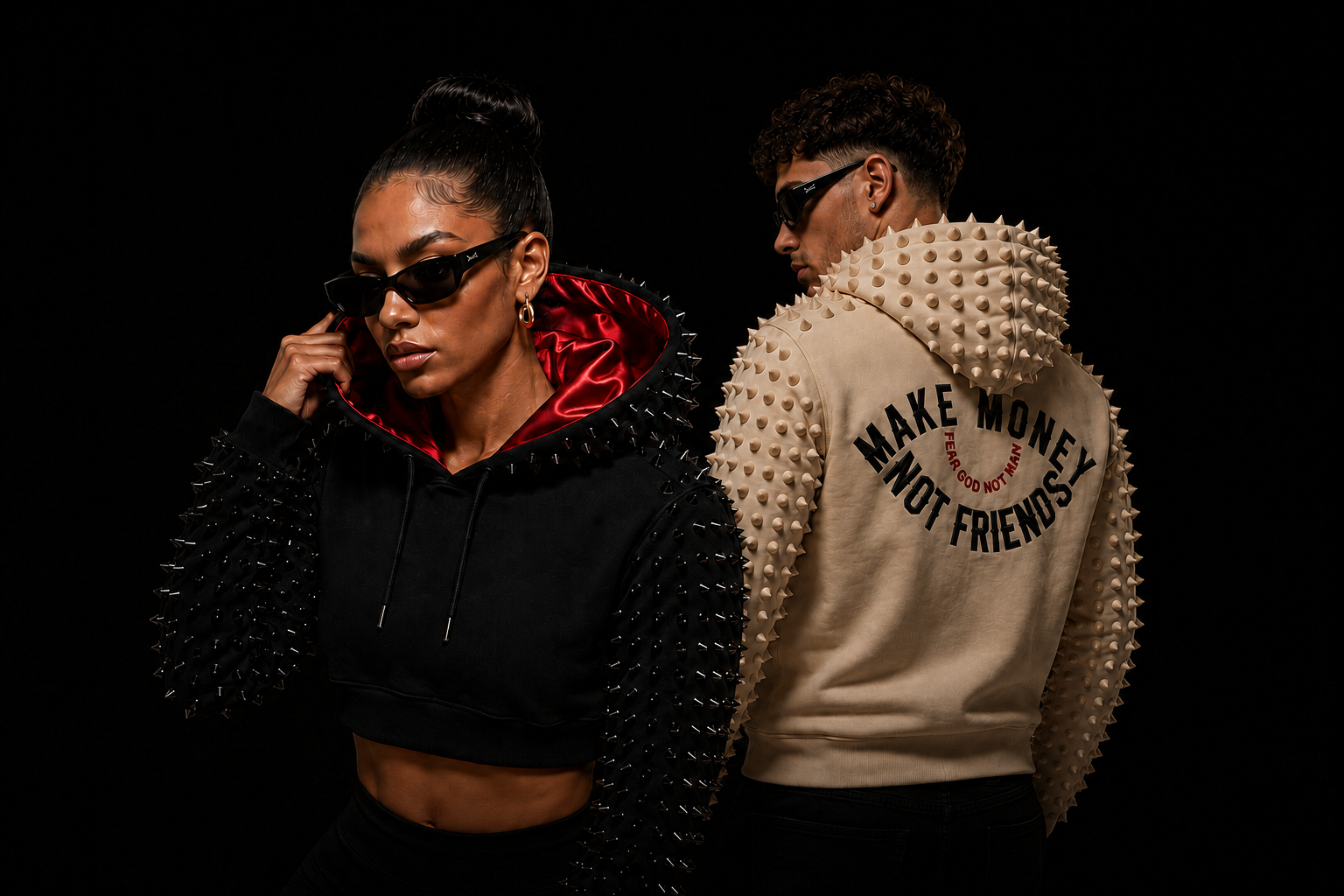
If your build or ambitions sit closer to the made-to-measure route, our limited drops carry the same materials and finishing without the wait of a full commission. Before you decide, our guide to measuring for a made-to-order piece walks through exactly what our atelier asks for, and a consultation approach similar to personalised styling guidance can help clarify what you actually need before you commit. Begin by exploring the Jeeyodee and enquire about atelier availability.
Sources
- Bespoke vs Made-to-Measure vs Off-the-Rack: What's Actually Different (2026) | Nathan Tailors
- Bespoke tailoring - Wikipedia
- What Is the Difference Between Custom and Bespoke Clothing? - Modaknits Apparel
FAQ
What does custom clothing actually mean?
"Custom" is generally used interchangeably with made-to-measure. It means an existing base pattern adjusted to your measurements, not a pattern drafted from scratch, which is what distinguishes it from true bespoke.
Is bespoke worth it over made-to-measure?
Bespoke is worth the extra cost and wait mainly for unusual proportions or for buyers who value a permanent, personal pattern and heavy handwork. For most standard bodies, made-to-measure delivers a comparable fit at a fraction of the price and time.
Do people commonly use the word 'bespoke' outside Britain?
The term originated in British tailoring and remains more common there, though it has spread into wider fashion vocabulary internationally, often more loosely than its original tailoring meaning.
What is the 3-3-3 rule for clothes?
It is a minimalist styling approach, wearing just three tops, three bottoms and three pairs of shoes on rotation for a set period, unrelated to how a garment is constructed or fitted. It has no bearing on choosing between custom, made-to-measure or bespoke tailoring.
How many fittings does bespoke tailoring involve compared with made-to-measure?
Bespoke typically involves two to three fittings, including a baste fitting that can reshape the pattern itself. Made-to-measure usually involves few fittings, since it starts from an already proven base pattern.