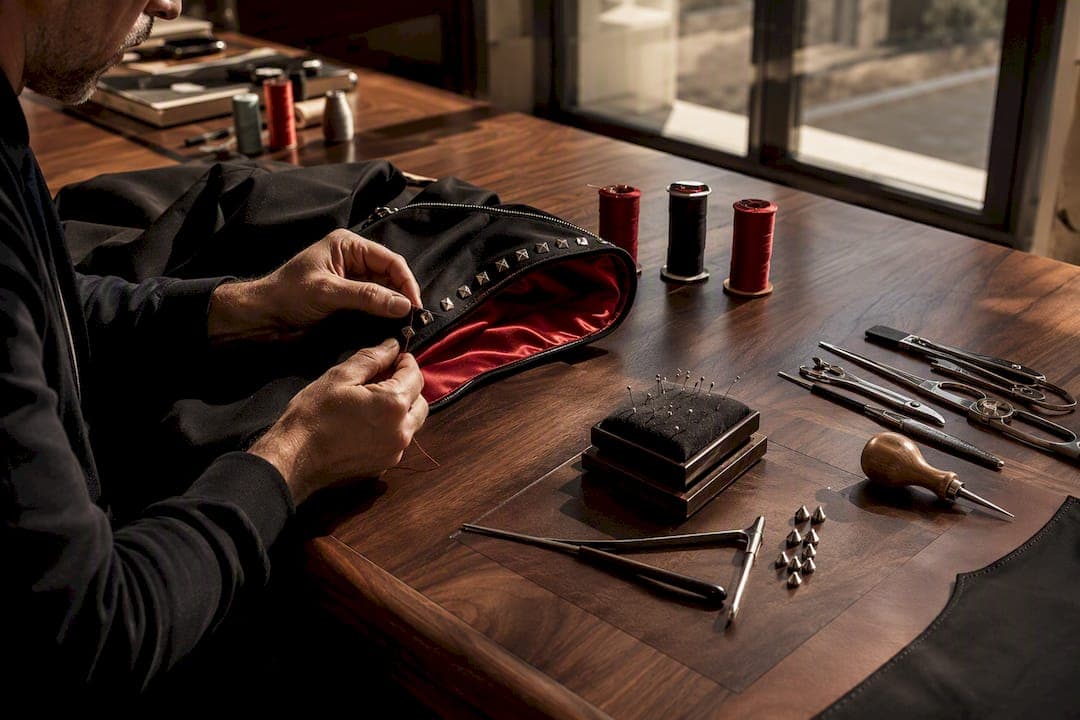
Hand finishing is the practice of shaping, seaming and securing a garment using needle and thread rather than machine stitching, at the specific points where drape, strength or invisibility matter most. It is not decoration. It is how a lapel learns to roll softly against the chest, how a hem falls without a ridge, and how a seam survives decades of wear without fraying. Understanding how hand finishing garments works means understanding three things it delivers that machines cannot reliably match:
- Superior drape — hand stitches flex with the fabric instead of locking it flat
- Discreet strength — certain hand stitches distribute stress invisibly across a seam
- Longevity — hand-felled linings and padstitched canvases age gracefully rather than cracking
A bespoke jacket's lapel is padstitched by hand because no machine can replicate the gentle, rolling shape a tailor builds stitch by stitch. A silk evening gown gets a hand-rolled blind hem because any machine stitch would show through fabric that fine. These are not stylistic flourishes. They are structural decisions.
Key Takeaways
Hand finishing works because human tension control and independently anchored stitches deliver drape, strength and longevity that machine lockstitching cannot replicate.
| Point | Details |
|---|---|
| Master six core stitches | Learn slip stitch, pickstitch, saddle stitch, cross-tack, hand-rolled hem and hand-sewn buttonholes before attempting couture finishing. |
| Match seam finish to fabric | Choose Hong Kong seams for heavy fraying wools, overcast for lighter fabrics, flat-fell for heavyweight cotton and denim. |
| Budget real apprenticeship time | Advanced tasks like handmade buttonholes typically need three to four months of concentrated practice to master. |
| Reserve hand work for value-critical points | Use machines for long straight seams and hands for lapels, hems and stress points where adaptive tension matters. |
| Jeeyodee applies these principles at atelier level | Hand-felled Egyptian silk linings and padstitching techniques shape every limited, individually numbered garment. |
Table of Contents
- How hand finishing garments works and why it matters
- What are the essential hand stitches in garment finishing?
- Which seam finishes do couture ateliers use?
- How does hand shaping give a garment its form?
- How are beading, appliqué and buttons secured by hand?
- What tools, needles and thread does hand finishing require?
- Where does hand finishing sit in the construction sequence?
- What are the most common hand finishing mistakes?
- Maison Jeeyodee: atelier practices and proof points
- How should you care for a hand-finished garment?
- Why has hand finishing endured across centuries of tailoring?
- How do hand finishing techniques differ by fabric type?
- When should you choose hand finishing over machine finishing?
- Why hand finishing still matters to us
- How to commission or buy a hand-finished Jeeyodee piece
- Sources
- FAQ
How hand finishing garments works and why it matters
Natural fibres do not behave like sheet metal. Wool eases, silk shifts, linen stretches unevenly along the bias, and a machine set to one tension cannot adapt mid-seam the way a hand adjusts pressure stitch by stitch. That adaptive control is the entire argument for hand work: a tailor feels resistance building in the cloth and responds instantly, easing fullness into a sleeve head or releasing tension across a curved dart. A machine simply cannot do that at a needle-by-needle level.
There is also a structural case, not just a tactile one. Hand-stitched seams take considerably longer to execute than their machine equivalents, but they reward that time with better drape and greater resilience, particularly on seams that flex with the body rather than sitting flat. A lockstitch, once broken, unravels along its length. Many hand stitches, by contrast, are anchored independently, so a single failure does not cascade.
Statistic Callout: Reaching consistency in advanced hand tasks such as bespoke buttonholes generally takes three to four months of concentrated apprenticeship practice — a timeline that explains why so few workshops still teach it properly.
Padstitching and hand-rolled hems change more than appearance. They change how a garment sits on a body over years, not just on the first wear.
Pro Tip: Practise new hand stitches on offcuts of the actual fabric you'll be finishing, not a test scrap of different weight. Wool flannel and silk crepe behave so differently under tension that muscle memory built on one will mislead you on the other.
What are the essential hand stitches in garment finishing?
Every serious maker needs a working vocabulary of six or seven stitches before attempting couture-level finishing. Each one solves a distinct structural or visual problem, and mixing them up is one of the fastest ways to weaken a garment or expose stitching that should stay hidden.
- Slip stitch (blind hem) — used for hems and linings where the stitch must vanish on the right side. Keep stitches roughly 1cm apart, catching only a thread or two of the outer fabric so nothing shows through when the garment is worn.
- Pickstitch and prick stitch — near-identical stitches used along jacket edges, lapels and pocket flaps for both structure and a whisper-thin decorative line. Many tailors work these in a fine Japanese silk thread at 8 to 10 stitches per inch, pulling just enough to let the lapel roll naturally rather than lie flat.
- Saddle stitch — a bolder, evenly spaced running stitch, often in contrasting thread, used where visible topstitching adds character without a machine's mechanical uniformity.
- Cross-tack — a small reinforcing stitch worked at stress points (pocket corners, pleat tops) to prevent tearing under repeated strain.
- Hand-rolled hem — the finish reserved for the finest fabrics. The rolled edge typically sits at around 3mm wide and reads as almost invisible from the right side, which is precisely why silk chiffon and fine cotton voile demand it.
- Hand-sewn buttonholes — arguably the steepest of all these skills to learn, requiring even keyhole shaping and consistent purl edges along both sides.
The difference between an amateur and an accomplished finish rarely comes down to which stitch was chosen. It comes down to spacing consistency and tension discipline across the whole garment.
Pro Tip: Mark your stitch spacing with a fine chalk line before you begin a long hand-rolled hem. Eyeballing spacing over a metre of fabric almost always drifts, and drift is far more visible than any single stitch.
Which seam finishes do couture ateliers use?
Seam finishing decides how a garment feels from the inside as much as how it performs from the outside. Four finishes dominate serious tailoring and dressmaking work, and each answers a different question about fabric weight, fraying tendency, and whether the interior will ever be seen.
- Hong Kong (bias-bound) seams — a strip of bias-cut lining fabric wraps the raw seam edge, hiding it entirely while keeping the seam flat and flexible. Ideal for unlined jackets and heavier wools that fray badly and need a clean, professional interior.
- Hand overcast (whipped) seams — a simple looping stitch worked over the raw edge to prevent unravelling on lighter, less fray-prone fabrics. Faster to execute than a Hong Kong finish, though less refined to the eye.
- Self-bound and flat-fell seams — the fabric folds over its own raw edge rather than needing a separate binding strip, producing a seam that is both durable and comfortable against the skin. Common on shirting and denim-weight cotton where chafing from a bulkier finish would be noticeable.
- Lining as a finishing decision — a fully lined garment often skips exposed seam finishing entirely, since the lining conceals the interior. That single choice reshapes which stitches a maker even needs to learn for a given piece.
Choosing wrongly here is subtle but costly: a Hong Kong finish on a sheer fabric adds unwanted bulk, while overcast stitching on a heavy wool coat simply will not hold against years of wear.
How does hand shaping give a garment its form?
Padstitching is the technique most responsible for a jacket's silhouette, and it is almost never done by machine in serious tailoring. Layers of canvas and, on traditional coats, horsehair interfacing are hand-felled into position and then stitched from wide, loose rows near the chest to increasingly fine, dense rows near the roll line. That gradient of density is what teaches a lapel to curve softly rather than fold sharply.
- Padstitching sequence — canvas is tacked, then stitched in graduated density, shaping form without adding visible bulk
- Hand-set sleeves — the sleeve head is eased in by hand, distributing fullness evenly so no pucker forms at the shoulder seam
- Hand-felled linings — attached with small, flexible stitches that let the lining move independently of the shell fabric
These steps stay in human hands because a machine applies uniform tension across a seam, and uniform tension is exactly wrong for a curved, three-dimensional shape like a shoulder or lapel roll.
Pro Tip: When easing a sleeve head, work in short sections rather than trying to distribute fullness across the whole armhole at once. Pin every two centimetres, checking the fabric lies flat before moving on.
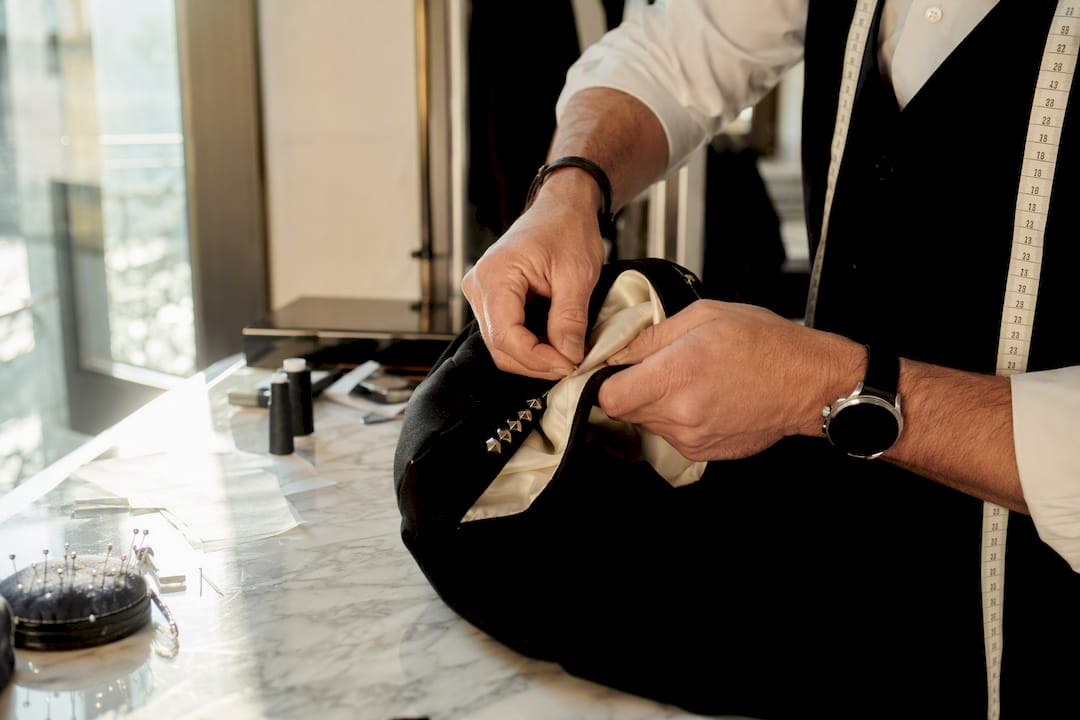
How are beading, appliqué and buttons secured by hand?
Decorative elements fail long before structural seams do, usually because they were attached with a single line of thread and no redundancy built in. Beading and sequin work should always use a knotted, doubled-back stitch every few beads, so a single broken thread does not release an entire row.
- Beading and sequins — knot off every third or fourth bead rather than running one continuous thread the length of a motif
- Appliqué and lace insertion — baste the motif in place first, easing any curved edges before the final invisible slip stitch
- Button attachment — wind a thread shank beneath the button so it sits slightly proud of the fabric, allowing it to fasten cleanly through a buttonhole without straining the threads
A garment finished this way is also easier to repair. A jeweller replacing a single lost bead, or a tailor reattaching a loose button, only has to work with the small, isolated section that failed, not unpick an entire seam.
What tools, needles and thread does hand finishing require?
The right needle and thread pairing matters as much as stitch technique. A needle too coarse for silk will leave visible holes; a thread too heavy for a rolled hem will show through the fabric it is meant to disappear into.
- Needles — fine "sharps" (sizes 10 to 12) for silk and delicate rolled hems; slightly heavier needles for wool canvas and padstitching
- Thread — silk thread for its strength-to-fineness ratio on couture work; polyester for everyday durability; waxed linen for buttonholes and structural tacks
- Building a gimp — when a matching commercial gimp thread isn't available, some ateliers twist two strands of silk thread together by hand to reinforce a buttonhole edge, a practical workaround worth knowing
- Supporting tools — a thimble, a tailor's clapper for crisp pressing, a tailor's ham for shaping curved seams, and fine glass-head pins that won't distort delicate weaves
Sourcing specialised threads and linings in-market usually means working directly with a tailoring supplier rather than a general haberdashery, particularly for silk gimp and fine linen thread.
Where does hand finishing sit in the construction sequence?
Hand work rarely opens a garment's construction. It follows machine-assembled panels, arriving once the shell is basted together and proportions can be checked on a form or a fitting. The sequence typically runs: prepare and cut, machine-baste the main seams, fit and adjust, then move into hand shaping (padstitching, sleeve setting), and finally hand finishing (hems, buttonholes, linings) once the garment's proportions are locked.
Statistic Callout: Given that advanced hand skills such as buttonholes take three to four months of dedicated apprenticeship to master, small ateliers often batch these tasks, reserving specific days for finishing work across several garments rather than treating each piece in isolation.
Machine processes still excel at repeatable, straight-line geometry, so a hybrid workflow, machine for long straight seams, hand for shaping and edges, raises output without sacrificing the details that actually define quality.
What are the most common hand finishing mistakes?
Most hand finishing faults trace back to one of three causes, and all three are fixable before a garment ever reaches pressing.
- Puckering — usually caused by uneven tension or stitches spaced too far apart on curved seams; ease the fabric more generously and shorten stitch length on tight curves.
- Uneven buttonholes — restitch rather than patch; an inconsistent keyhole shape rarely improves with a partial fix.
- Visible thread on the right side — check needle angle and reduce the amount of fabric caught with each stitch; a shallower bite keeps stitches buried in the underside.
- Final inspection — always check a hand-finished garment against strong light before pressing, since raking light reveals tension inconsistencies invisible under normal room lighting.
Maison Jeeyodee: atelier practices and proof points
Every hand-finished piece from Jeeyodee begins with material specification, not stitch count. Egyptian silk hood linings are hand-felled into place using the same graduated tension principles that shape a bespoke lapel, and needle and thread pairings are chosen garment by garment to balance next-to-skin comfort with decades of wear.
- Hand-felled linings finished to move independently of the heavyweight cotton shell
- Padstitching principles applied wherever structure needs to hold its shape without bulk
- Hand-rolled hem techniques reserved for the finest interior seams
Explore the full philosophy behind these choices in our guide to luxury garment finishing details and the collector's guide to silk interiors.
How should you care for a hand-finished garment?
A hand-finished garment asks for gentler handling than a mass-produced equivalent, not because it is fragile, but because its construction rewards care that machine-stitched seams simply don't need. Hand-felled linings, in particular, can loosen if a garment is machine-washed on a standard cycle, since the small, flexible stitches that let the lining move independently were never designed to withstand agitation.
Dry cleaning remains the safest route for anything with padstitched canvas, hand-rolled hems, or silk lining, since water and heat can shrink canvas unevenly and distort a lapel roll that took hours to shape. Between cleans, brushing wool with a soft garment brush lifts surface dust without disturbing stitching, and hanging on a properly shaped wooden hanger, never wire, preserves the shoulder line that hand-set sleeves were built to hold.
Repairs should go to someone who understands hand construction rather than a general alterations counter. A loose button reattached with a modern thread shank will hold, but a hand-rolled hem repaired with a machine stitch permanently changes how that edge behaves against the body. Store hand-finished pieces with breathing room in a wardrobe rather than compressed between other garments; the same easing and tension that shaped a sleeve or lapel can be gradually flattened by prolonged pressure.
Treated well, a hand-finished garment does not simply last longer. It develops a softness and drape over years of wear that a machine-finished equivalent never quite reaches, because the fibres were never forced into a rigid, uniform tension to begin with.
Why has hand finishing endured across centuries of tailoring?
Long before industrial sewing machines existed in the 19th century, every seam, hem and buttonhole in Western dressmaking was hand-worked out of necessity rather than preference. What changed after mechanisation was not whether hand skills were useful, but where they were reserved. Tailoring houses kept hand finishing precisely at the points machines handled poorly: shaping a lapel roll, easing a sleeve head, rolling a silk hem invisibly thin.
That decision, made over a century ago, still defines couture today. Savile Row's bespoke tradition and the ateliers of Parisian haute couture both built their reputations on retaining hand skills that mass manufacturing abandoned entirely. The techniques did not survive because they were nostalgic. They survived because human judgement continues to correct subtle deviations that automated processes cannot detect, a principle documented well beyond textiles, in precision watchmaking and fine horological finishing alike.
There is also a cultural dimension that outlasts fashion trends. A hand-finished garment carries the trace of the individual who made it, in the very slight irregularities that no two hands produce identically. That signature has always separated a bespoke or couture piece from something assembled purely by specification. It is why a hand-rolled hem from one tailor never looks quite like another's, even when both follow the same technique to the letter.
How do hand finishing techniques differ by fabric type?
Fabric weight and fibre behaviour dictate which hand technique actually works, and applying the wrong one is one of the most common errors among makers moving from cotton to silk or heavy wool.
Sheer and lightweight fabrics, silk chiffon, fine cotton voile, silk charmeuse, demand a hand-rolled hem almost exclusively. Any machine stitch or bulkier hand stitch shows through the fabric or distorts its drape entirely. Prick stitch and pickstitch also need adjustment on these fabrics: threads must be fine enough that the stitch reads as a texture rather than a visible line.
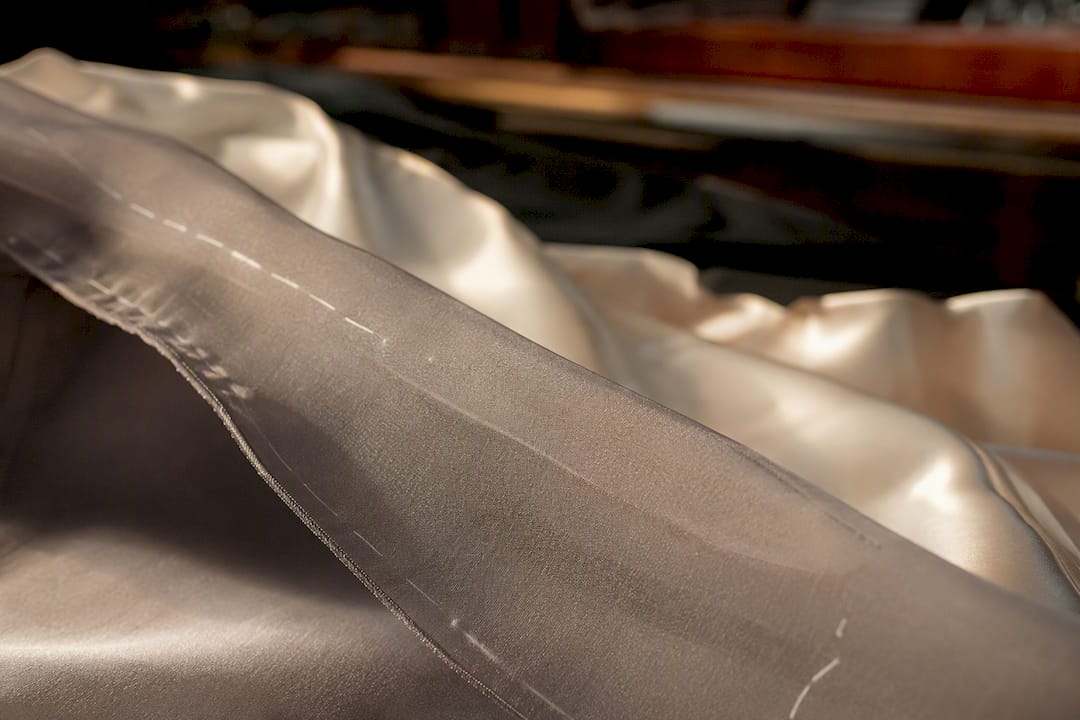
Mid-weight fabrics such as wool suiting and cotton shirting suit a broader range of techniques. Hong Kong seams work well here because the fabric holds a bias binding cleanly without excess bulk, and padstitching performs at its best on wool canvas, which has the natural resilience to hold a shaped roll over years.
Heavyweight fabrics, structured wool coating, denim, heavyweight cotton, favour flat-fell and self-bound seams over binding techniques, since adding a separate bias strip to already-thick fabric creates unnecessary bulk at the seam. These fabrics also tolerate a firmer hand in padstitching, since the fibres hold shape more readily than lighter cloth.
Leather and technical textiles sit outside most traditional hand-stitch vocabulary altogether, generally needing specialised needles and often a different stitch geometry entirely, a reminder that no single technique applies universally across every material a maker might encounter.
When should you choose hand finishing over machine finishing?
The decision rarely comes down to skill level alone. It comes down to what a specific seam or edge needs to do, and matching the tool to that requirement rather than defaulting to habit.
Choose hand finishing when drape matters more than speed, on rolled hems in fine fabric, on lapels and collars that need to curve rather than fold, and on any seam where visible machine stitching would compromise the garment's appearance from the inside or out. Durability also favours hand work on stress points like pocket corners and buttonholes, where independently anchored stitches resist cascading failure better than a continuous lockstitch.
Choose machine finishing for long, straight structural seams where speed and consistency matter more than adaptive tension, side seams on trousers, main construction seams on shirting, anywhere fabric behaviour is predictable and uniform. The time cost is the deciding factor here: a hand-finished seam can take several times longer than its machine equivalent, and that cost only pays off where the visual or structural benefit is genuine, not decorative.
Most well-made garments, including everything Jeeyodee produces, use both deliberately. Machine work handles the seams that benefit from speed and uniformity. Hand work is reserved for the points where a garment's character, comfort and longevity actually get decided.
Why hand finishing still matters to us
We believe a garment earns permanence through the hands that shaped it, not the machinery that assembled it. Every irregularity in a hand-rolled hem or a padstitched lapel is proof of a decision made by a person, not a setting on a machine. That is not sentiment. It is why our pieces are made once, numbered, and never repeated: hand finishing cannot be mass-produced, so neither should the garment it belongs to.
— Jeeyodee
How to commission or buy a hand-finished Jeeyodee piece
Jeeyodee produces strictly limited, individually numbered garments made in Italy, each one hand-finished with details like Egyptian silk hood linings and meticulously aligned Italian cone studs, that are never reproduced once a drop sells through. Where an off-the-rack drop doesn't answer the exact brief a collector has in mind, atelier commissions are available: a 50% deposit secures your place, with final pricing and timelines agreed privately before work begins. Browse current and upcoming pieces, or open a conversation about a bespoke commission, at the Jeeyodee store.
Sources
- How to sew pick stitch | Simplicity
- Luxury fashion hand finishing: the art of quality | SELVANE
- Some thoughts on hand finishing | Thumb Thimble
- Hand finishing at Patek Philippe | Patek Philippe
FAQ
How do you finish fabric edges by hand?
Fold and press the raw edge, then secure it with a slip stitch, overcast stitch, or a hand-rolled hem depending on fabric weight, with fine sheer fabrics almost always calling for a rolled hem.
What are the four main types of edge finishing?
The four most common couture edge finishes are Hong Kong (bias-bound), hand overcast (whipped), self-bound, and flat-fell, each suited to different fabric weights and fraying tendencies.
How do you end off when hand sewing?
Take two small backstitches on top of each other in the same spot, then run the needle through the fold of a hem or seam allowance before trimming, so the knot stays hidden.
What are the eight stages of garment construction?
Stages typically run: pattern preparation, cutting, marking, machine basting, fitting, hand shaping such as padstitching, hand finishing of hems and buttonholes, and final pressing, though exact sequencing varies by atelier.
When should I choose hand finishing over machine finishing?
Choose hand finishing for hems, lapels and stress points where drape and discreet strength matter, and machine finishing for long structural seams where speed and consistency are the priority.