
Design boundaries on personalisation are not not a maison's reluctance to please. They are the mechanism by which rarity, craftsmanship and identity survive contact with individual taste. Maison Jeeyodee treats every limit as a form of protection, not refusal. A collector may adjust the small things; the maison guards the things that make a piece recognisable and, ultimately, worth keeping.
TL;DR:
- Customization on limited-edition luxury garments is restricted to preserve the integrity of signature motifs, silhouettes, and hand-finished details.
- Most maisons limit monogram placement, color choices, and motif size to maintain visual hierarchy and design balance.
- Excessive personalisation erodes the garment's signaling value and can undermine its long-term collectibility and resale credibility.
- Bespoke commissions involve close collaboration, stage fittings, artisan input, and documentation, making them more flexible but still bounded by design constraints.
- Procurement of signed spec sheets, numbering confirmation, and atelier photographs is essential to protect provenance and future value.
Table of Contents
- What limiti personalizzazione capi actually means for a collector
- Why maisons set boundaries on personalisation
- Typical design-led limits you will encounter
- How bespoke commissions work when limits are negotiable
- A collector's checklist for personalisation conversations
- A maison's voice: Jeeyodee on limits, craft and collectibility
- Begin a commission with Maison Jeeyodee
- Sources
- FAQ
What limiti personalizzazione capi actually means for a collector
Ask a maison what can be changed on a limited piece, and you are really asking how much of the design's authorship you are permitted to borrow. That is the substance behind limiti personalizzazione capi, the design-led restrictions a luxury house places on customising an already-conceived garment. These are not production constraints imposed by a print shop or an embroidery vendor. They are deliberate, aesthetic decisions made to protect the integrity of a piece that will never be produced again.
Custom apparel options in mainstream fashion tend to be broad because the garment itself carries little independent design authority. A hoodie without provenance can absorb almost any alteration and lose nothing, because it had nothing singular to lose. A numbered piece from a single run is different. Its value is bound up in a specific silhouette, a specific hand-finish, a specific narrative. Loosen those elements too far and the object stops being that piece and becomes something else entirely, something the maison never authored.
Clothing personalisation limits, in other words, exist to keep the relationship between designer intent and finished garment intact. Apparel design flexibility has a ceiling in this world, and that ceiling is deliberate.
Why maisons set boundaries on personalisation
Design equity is the quiet currency behind every limited release. It is the accumulated trust a maison builds by keeping its visual language consistent, piece after piece, so that a garment is instantly legible as theirs. Customisation, left unchecked, spends that currency fast.
Research from SDA Bocconi describes an inverted-U relationship between design freedom and purchase intent for luxury goods: moderate personalisation lifts desirability, but past a certain point, further customisation erodes it. Buyers stop reading the garment as a signal of taste and start reading it as a compromise.
That erosion is not abstract. WU Vienna's research found that excessive customisation weakens a luxury product's signalling value among fashion-conscious buyers, precisely the audience a maison exists to serve. Scholarship summarised by the American Marketing Association frames this as a tension between perceived uniqueness and design equity: personalisation can make a piece feel more personal while simultaneously making it feel less prestigious, if the two forces are not balanced with discipline.
A few consequences follow directly from this research:
- Limited production runs preserve the provenance a collector is actually buying.
- Hand-finishing by named artisans, as practised across Jeeyodee's Thorns edition, only holds meaning if the underlying design stays consistent.
- Calibrated design freedom, not unlimited choice, is what sustains long-term value.
The evidence is consistent across markets: moderate personalisation helps a luxury piece; unrestricted personalisation quietly undermines it.
Typical design-led limits you will encounter
Every maison draws its boundaries in slightly different places, but certain restrictions recur across the industry because they protect the same things: silhouette, hierarchy, and hand.
-
Monogramming rules. Most houses cap letter count and dictate placement, often permitting an internal monogram (inside a hood lining, along a seam) while restricting anything external that competes visually with the maison's own signature. The reasoning is hierarchy: your initials should never outrank the design.
-
Colour and dye constraints. A collection's palette is chosen to hold together as a set. Introducing an off-palette dye can also compromise how a fabric behaves over years, which matters enormously on a piece meant to be worn, not shelved.
-
Placement and scale restrictions. Signature motifs, like the thorn detailing on certain Jeeyodee releases, occupy a fixed position and proportion for a reason. Move or enlarge them and you disturb the visual balance the designer calculated deliberately.
-
Structural and hardware limits. Requests to swap signature hardware, such as aligned Italian cone studs, or to alter the cut of a garment, are almost always declined. These elements are part of the engineering of the piece, not decoration layered on top of it.
-
Numbering integrity. Any change substantial enough to alter the garment's identity risks invalidating its individual number, which is the single detail that anchors its provenance and, eventually, its resale credibility.
Pro Tip: Ask a maison how a proposed change would appear on the garment's certificate of numbering. If the answer is vague, the change probably falls outside what the piece can absorb without losing its identity.
How bespoke commissions work when limits are negotiable
A limited-edition drop and a bespoke commission are governed by different rules, and understanding the difference matters before you approach an atelier with a request.
A single-run release is fixed at conception. Its personalisation ceiling is narrow because the design has already been finalised and reproduced across a small, numbered batch. A bespoke commission is something else: a genuine collaboration, built from the ground up around one collector and one artisan relationship.
The atelier process typically unfolds in stages:
- An initial consultation to establish scope, materials and the boundaries the maison is willing to move within.
- Fittings and iterative adjustment, where cut and proportion are refined against the collector's body and preference.
- Direct collaboration with the artisan responsible for hand-finishing, silk lining, or embroidery detail, as outlined in Jeeyodee's bespoke fitting process.
- Sample review and final approval before the piece is committed to production.
Because a commission removes a garment permanently from any future run, ateliers typically request a deposit, commonly 50%, before work begins. This underwrites the artisan hours involved and formalises the exclusivity the collector is paying for. On completion, expect documentation befitting the piece itself: an individual number, a certificate, and often process photography that records the garment's making, not merely its finished state.
A collector's checklist for personalisation conversations
Walking into an atelier conversation prepared changes the outcome. A few direct questions protect both your interests and the piece's future value.
Ask early: What exactly can be altered without affecting the garment's number? Will this change be documented on a signed specification sheet? Does this personalisation affect resale value, and can that be confirmed in writing rather than promised verbally?
Acceptable micro-personalisations tend to sit quietly, discreet internal embroidery, a choice of silk lining colour where the maison offers one, an internal monogram tucked from view. Jeeyodee's approach to personalised embroidery on hoodies illustrates how selective detail can be added without disturbing the garment's public identity.
Treat these as warning signs:
- A request to modify or resize the maison's signature motif or logo.
- Any promise of exclusivity or provenance that exists only verbally, with nothing on paper.
- Pressure to finalise a major silhouette change without a fitting or sample stage.
Pro Tip: Never rely on an email thread alone. Ask for a signed spec sheet, numbering confirmation, and dated atelier photographs before final payment, this is what protects the piece's provenance years from now.
A maison's voice: Jeeyodee on limits, craft and collectibility

We build every piece around a conviction: a garment earns its permanence, it is not decorated into existence. Single-run production and hand-finishing, Egyptian silk hood linings, meticulously aligned Italian cone studs exist because a maison's signature must survive contact with individual taste, not dissolve under it.
Selective embroidery, offered on certain releases, is not a concession to personalisation. It is a controlled act of co-authorship, one that deepens collectibility rather than diluting it. When a collector approaches us wanting to make a piece their own, we welcome the conversation. We simply ask that it begin with understanding what the garment already is, before deciding what it might become.
— Jeeyodee
Begin a commission with Maison Jeeyodee
Jeeyodee offers what a mass customisation service cannot: a garment authored once, numbered individually, and never repeated, so the limits you meet in conversation are the same limits that protect the piece's future worth.
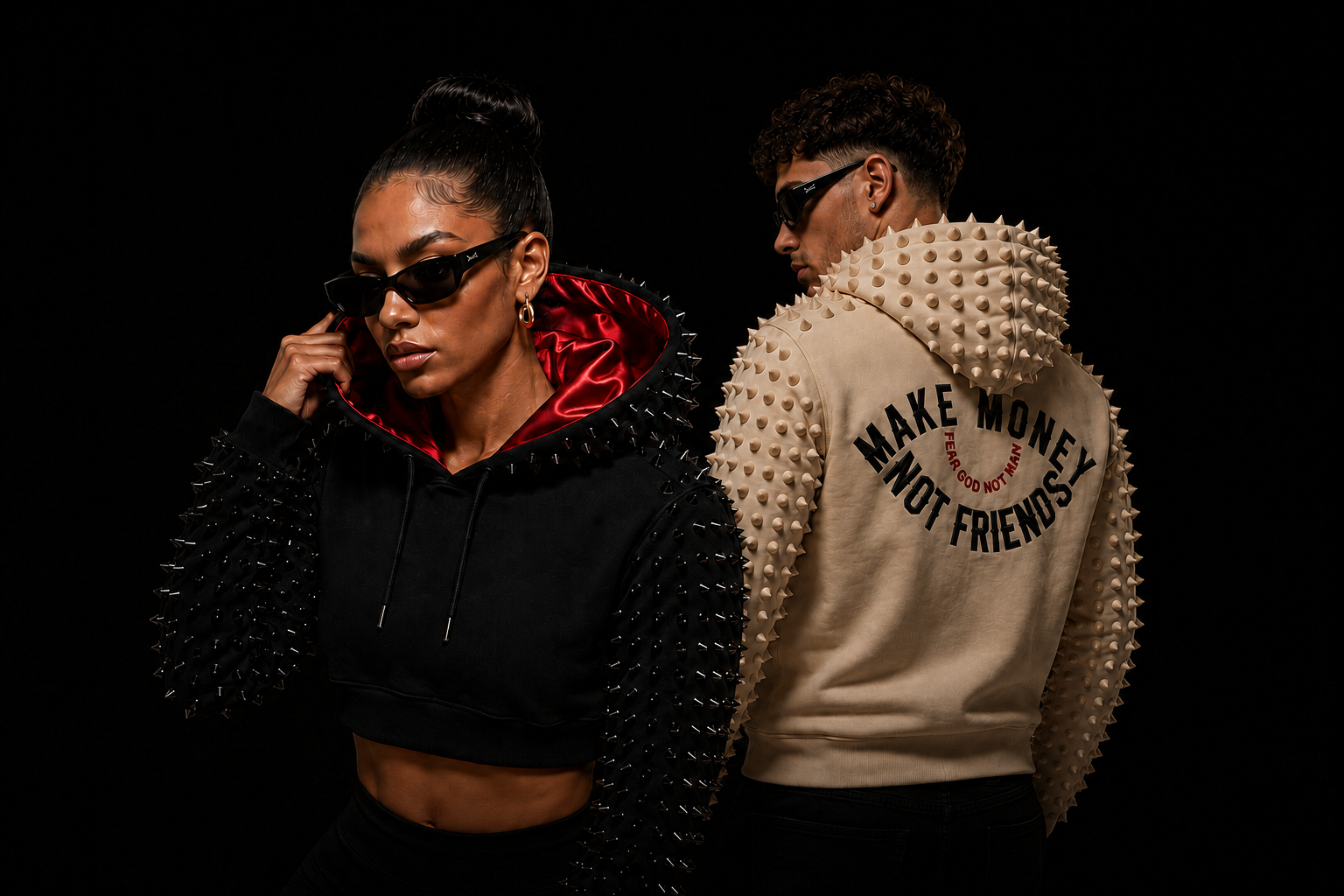
Starting a commission is straightforward. Submit an enquiry describing what you have in mind, confirm the piece with a deposit once scope is agreed, then move through fittings and artisan collaboration before final approval and numbering. Every commission is hand-finished in Italy and documented from first sketch to final stitch, so provenance is never in question. If you are ready to discuss what is possible within Jeeyodee's design language, begin your enquiry with the maison and an atelier representative will guide you through deposit and fitting expectations.
Sources
- Product customization in the luxury market | SDA Bocconi
- Luxury brands and the pitfalls of customization — WU Vienna press release
- When customization in luxury brands gets too personal | AMA
- Thorns edition | Jeeyodee
FAQ
What are personalisation limits on a luxury garment?
They are the design-led boundaries a maison sets on altering a limited-edition piece, protecting silhouette, signature motifs and hand-finishing so the garment keeps its intended identity and provenance.
Can I request a monogram on a Jeeyodee piece?
Selective, discreet personalisation such as internal embroidery is possible on certain releases; visible changes to signature motifs or hardware are generally not, to preserve design equity across the collection.
How is a bespoke commission different from buying a limited drop?
A limited drop is fixed at design and produced once in a small numbered run, while a bespoke commission is a collaborative process with fittings, artisan input and a deposit, commonly 50%, that removes the piece from future production entirely.
Do personalisation limits affect resale value?
Generally, respecting design-led limits preserves resale value because collectors and future buyers rely on unaltered signature elements and intact numbering as proof of authenticity.
What documentation should I request for a bespoke piece?
Ask for a signed specification sheet, confirmation of individual numbering, a certificate, and dated atelier photographs, which together protect the piece's provenance over time.