TL;DR:
- Building a sustainable luxury wardrobe involves choosing high-quality, timeless garments designed to last across seasons and trends. It emphasizes intentional purchasing based on craftsmanship, durability, and genuine need, not volume or fleeting trends. Prioritizing quality, transparency, and maintenance reduces waste and creates a wardrobe of lasting character.
A sustainable luxury wardrobe is defined as a curated collection of timeless, high-quality garments built to endure across seasons, decades, and shifting trends. This is not minimalism for its own sake. It is the discipline of choosing fewer pieces with greater conviction, where each acquisition earns its place through craftsmanship, provenance, and permanence. The slow fashion movement formalises what discerning dressers have always known: quality buying reduces wardrobe waste, lowers long-term cost, and produces a wardrobe that reflects genuine character rather than fleeting appetite. A quality over quantity philosophy is not a trend. It is the foundation of every wardrobe worth building.
What does building a sustainable luxury wardrobe actually require?
The industry term for this practice is investment dressing, and it rests on a single principle: the true cost of a garment is not its price tag but its cost per wear. A £500 coat worn 200 times costs £2.50 per wear, far less than a £100 coat worn only ten times. That arithmetic changes how you shop entirely.
Sustainable wardrobe building also demands clarity about what you actually wear. Most people reach for the same 20% of their wardrobe 80% of the time. Acknowledging that reality is the first act of discipline. The goal is not a smaller wardrobe for its own sake. The goal is a wardrobe where every piece is worn, cared for, and valued.
Craftsmanship sits at the centre of this philosophy. Garments built with exceptional construction last longer, require fewer replacements, and carry a dignity that mass-produced pieces cannot replicate. When ownership becomes attachment, a garment stops being a purchase and becomes a permanent chapter in your personal history.
How do you identify truly sustainable luxury pieces?
Identifying genuine sustainability requires looking past marketing language. Credible brands provide fibre content, manufacturing information, and third-party certifications without being asked. If a brand cannot tell you where its fabric was woven or who cut the pattern, that silence is informative.
Certifications that carry real weight
The certifications worth trusting are specific and independently verified:
- GOTS (Global Organic Textile Standard): Covers the entire supply chain for organic fibres, from field to finished garment.
- OEKO-TEX Standard 100: Certifies that every component of a garment, including threads and buttons, is free from harmful substances.
- Fair Trade Certified: Confirms fair wages and safe conditions for the people who made the piece.
- B Corp: Measures a brand's overall social and environmental performance, not just its products.
These certifications are not decorative. Each one requires independent auditing and renewal. A brand displaying all four has submitted itself to genuine scrutiny.
Recognising greenwashing
Greenwashing is the practice of using environmental language without substantive commitment behind it. Watch for vague claims such as "eco-conscious," "green," or "sustainable collection" without supporting evidence. Scrutinise brand transparency and certifications before accepting any sustainability claim at face value. A brand with genuine credentials will direct you to specifics. A brand without them will redirect you to aesthetics.
Pro Tip: Search a brand's website for its supply chain page or impact report. If neither exists, the sustainability claim is marketing, not practice.
How to curate a versatile, timeless capsule wardrobe
A capsule wardrobe is a tightly edited collection of pieces that work together across multiple contexts. The principle is mathematical: a 20-piece capsule wardrobe can yield over 50 distinct outfit combinations when pieces are chosen for compatibility and versatility. That efficiency reduces both carbon impact and the compulsion to keep buying.
Building your capsule with intention
Follow this sequence when constructing or editing your wardrobe:
- Audit what you already own. Lay everything out. Identify the pieces you reach for repeatedly. These are your anchors.
- Remove what you have not worn in twelve months. Donate, resell, or repair. Do not keep pieces out of guilt.
- Map genuine gaps. A gap is a specific need, not a vague desire. "I need a structured coat in a neutral tone" is a gap. "I want something new" is not.
- Apply the 30-wear rule before every purchase. Experts recommend wearing a piece at least 30 times before committing to buy. If you cannot picture 30 occasions, the piece does not belong in your wardrobe.
- Prioritise neutral, adaptable tones. Ivory, charcoal, navy, and camel work across seasons and contexts. Statement pieces earn their place only when they pair with at least three existing items.
Capsule wardrobe efficiency at a glance
| Wardrobe type | Approximate pieces | Outfit combinations | Long-term cost |
|---|---|---|---|
| Trend-driven closet | 80+ | Inconsistent | High, frequent replacement |
| Curated capsule | 20–30 | 50+ | Lower, fewer replacements |
| Luxury capsule | 15–25 | 50+ | Highest upfront, lowest over time |
Capsule wardrobes with versatile pieces significantly reduce long-term carbon footprint. The environmental benefit is not incidental. It is the direct result of buying less and buying better.
Pro Tip: Photograph your existing wardrobe and organise the images by category. Seeing your pieces as a collection, rather than a rail, reveals compatibility and gaps far more clearly than browsing in person.
How to assess quality and craftsmanship in luxury garments
Quality is often indicated by fabric heft, stitch precision, and thoughtful construction details. These are not superficial markers. They are the physical evidence of time, skill, and material investment.
What to examine on every garment
- Fabric weight and composition. Natural fibres such as organic cotton, linen, wool, and Egyptian silk carry density and breathability that synthetic blends cannot replicate. Heavyweight cotton holds its structure across years of wear. Egyptian silk, used by Jeeyodee as a hood lining, adds a tactile richness that signals genuine material conviction.
- Seam construction. Flat-felled seams and French seams outlast overlocked edges. Run your finger along interior seams. Fraying or looseness at the outset predicts failure under regular use.
- Stitch density. Dense stitching and reinforced seams correlate directly with durability. Count stitches per centimetre on a visible seam. Fewer than eight stitches per centimetre is a warning sign.
- Bar-tacking and stress points. Reinforced bar-tacking at stress points and thread shanks on buttons protect garment integrity beyond what surface inspection reveals. Check pocket corners, belt loops, and button attachments.
- Hardware quality. Metal hardware should feel substantial and move smoothly. Plastic or lightweight metal zips and clasps fail first and are rarely repairable.
- Lining. A full lining protects the outer fabric by absorbing friction and body oils, extending garment lifespan considerably. The presence of a quality lining is one of the clearest signals of considered construction.
Evaluating quality when shopping online
Without tactile access, rely on these indicators: detailed flat-lay photography showing seam construction, published fabric weights in grams per square metre, named fabric mills or origins, and explicit descriptions of construction techniques. Brands that craft with genuine conviction describe their process because the process is part of the value.
Pro Tip: Request a close-up image of the interior seams and lining before purchasing online. A brand confident in its construction will send one without hesitation.
Best practices for purchasing, maintaining, and caring for your wardrobe
Sustainable wardrobe building is a slow, focused process that prioritises frequently worn items over rapid overhaul. The discipline is not in the buying. It is in the restraint, the care, and the willingness to repair rather than replace.
A sustainable fashion purchasing checklist
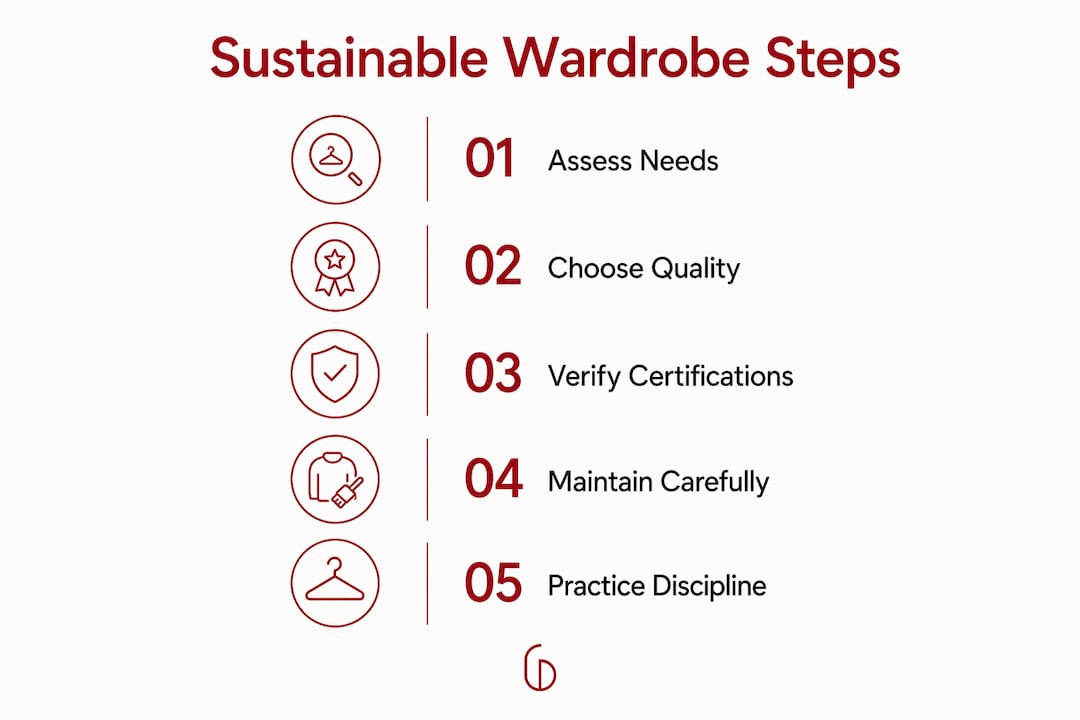
Before every purchase, work through these five questions:
- Does this piece fill a specific, identified gap in my wardrobe?
- Can I wear it at least 30 times across different contexts?
- Does the brand provide transparent supply chain and material information?
- Is the construction quality consistent with the price being asked?
- Does it work with at least three pieces I already own?
If any answer is no, wait. Delay is not indecision. It is discipline.
Garment care as a sustainability practice
Caring for what you own is as important as what you choose to buy. Wash garments at the lowest effective temperature. Air dry rather than tumble dry wherever possible. Spot clean minor marks immediately to avoid full washes. Store knitwear folded, never hung, to prevent distortion. These habits extend garment life by years.
"Each thoughtful acquisition or care effort is a step toward reducing wardrobe waste. Sustainable wardrobe building includes secondhand shopping, careful care, repair, and slow, intentional purchases."
Repair is the most underused tool in sustainable dressing. A skilled tailor can reinforce a worn seam, replace a button, or re-line a jacket for a fraction of the cost of replacement. Secondhand and repair services form a vital part of the circular fashion economy. Seeking them out is not compromise. It is conviction.
Pro Tip: Find a trusted tailor before you need one. Knowing repairs are accessible makes you more willing to invest in quality pieces, because you know they can be maintained.
Key takeaways
A sustainable luxury wardrobe is built through deliberate acquisition, rigorous quality assessment, and disciplined care, not through volume or speed.
| Point | Details |
|---|---|
| Cost-per-wear is the true measure | A £500 coat worn 200 times costs less per wear than a £100 coat worn ten times. |
| Certifications confirm real sustainability | GOTS, OEKO-TEX, Fair Trade, and B Corp each require independent auditing, not self-declaration. |
| A 20-piece capsule yields 50+ outfits | Versatile, neutral pieces outperform larger trend-driven wardrobes in both style and carbon efficiency. |
| Construction details predict longevity | Bar-tacking, dense stitching, full linings, and metal hardware are the markers of garments built to last. |
| Repair and restraint reduce waste | Delaying purchases and maintaining what you own does more for sustainability than any single ethical buy. |
Why we build slowly at Jeeyodee
The question we are asked most often is why every Jeeyodee piece is made once and never reproduced. The answer is not scarcity for its own sake. It is a refusal to participate in the cycle of excess that defines so much of the industry we work within.
We have watched the fashion world accelerate past the point of meaning. Drops become noise. Collections become catalogues. The garment stops being an object of conviction and becomes a unit of throughput. We find that intolerable.
What we believe, and what our atelier in Italy practises, is that a garment should cost the maker something. Time. Skill. Attention. The heavyweight cotton we use, the Egyptian silk linings, the individually aligned Italian cone studs: none of these are incidental. They are the physical form of a decision to do things properly. When you wear a numbered Jeeyodee piece, you are wearing the evidence of that decision.
Sustainable luxury is not a category. It is a posture. It means choosing the piece that will still matter to you in ten years, the one built by hands that understood what they were making. We do not believe in wardrobes assembled quickly. We believe in wardrobes assembled with permanence in mind. That is the only kind worth building.
— Jeeyodee
Jeeyodee and the art of the considered acquisition
Every principle in this guide, from cost-per-wear discipline to construction scrutiny, points toward the same conclusion: the garments worth owning are the ones made with genuine craft and finite intention.
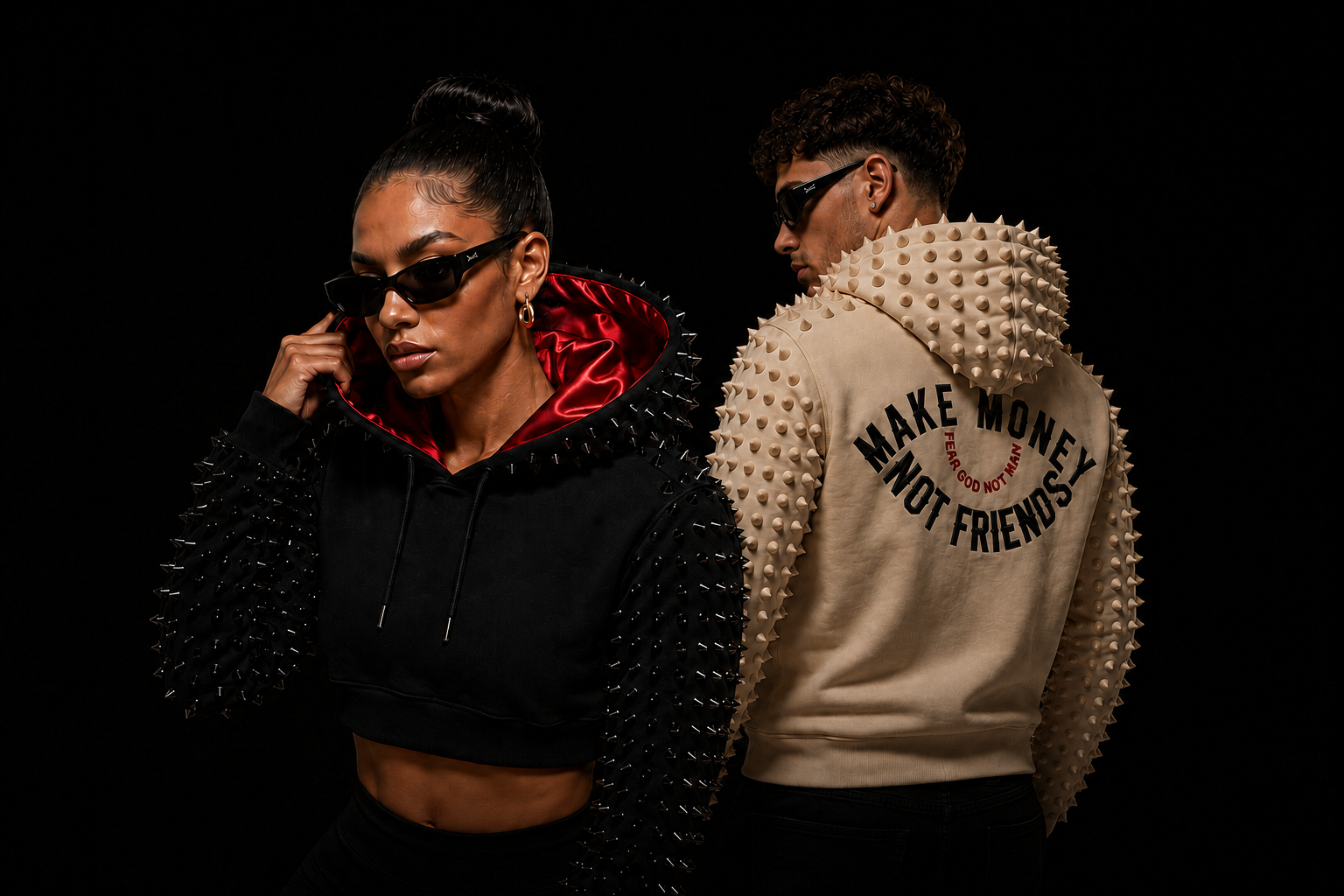
Jeeyodee's pieces are handcrafted in Italy, individually numbered, and produced in strictly limited drops that are never repeated. Each garment carries Egyptian silk hood linings and meticulously aligned Italian cone studs, details that exist not for decoration but as evidence of the atelier's standards. When a drop closes, it is closed permanently. That scarcity is not a marketing device. It is the natural consequence of making things properly. Readers building a wardrobe with permanence in mind will find the Jeeyodee collection a precise expression of everything this guide advocates.
FAQ
What is a sustainable luxury wardrobe?
A sustainable luxury wardrobe is a curated collection of high-quality, ethically produced garments chosen for longevity, craftsmanship, and versatility rather than trend or volume. The focus is on pieces that endure across seasons and retain their value over years of wear.
How does the 30-wear rule work?
The 30-wear rule requires you to confirm you will wear a piece at least 30 times before purchasing it. This single question breaks the cycle of impulsive buying that drives wardrobe waste.
Which certifications should I look for in sustainable luxury fashion?
Look for GOTS, OEKO-TEX Standard 100, Fair Trade, and B Corp. Each requires independent verification and covers different aspects of ethical and environmental production.
How many pieces does a capsule wardrobe need?
A 20-piece capsule wardrobe can produce over 50 outfit combinations when pieces are chosen for compatibility. Quality and versatility matter far more than quantity.
Is secondhand shopping part of a sustainable luxury wardrobe strategy?
Secondhand shopping is a core element of reducing wardrobe waste and supports the circular fashion economy. Pre-owned luxury pieces often carry superior construction to new mid-market alternatives, making them both ethical and practical acquisitions.