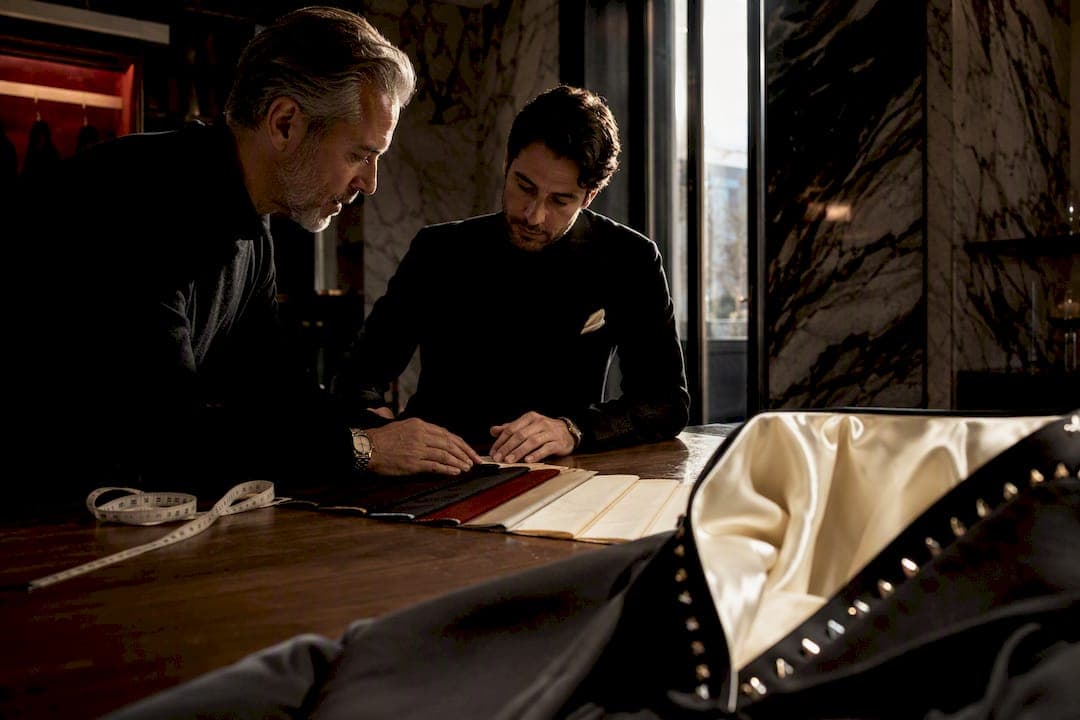
Yes, a deposit is normal practice for su misura commissions in Italy, and ateliers typically frame it as a caparra confirmatoria under article 1385 of the Civil Code, not a casual advance. The benchmark most maisons use is a substantial deposit, though the amount moves with fabric rarity and workmanship. Paying it secures your production slot, your materials, and the atelier's commitment to the calendar it agrees with you.
TL;DR:
- The standard deposit for a made-to-measure commission is usually around half the total price, especially for complex or limited fabric pieces.
- The deposit must be explicitly labeled as "caparra confirmatoria" in a written order to trigger legal remedies if the client withdraws or the atelier defaults.
- Paying the deposit at order confirmation secures the materials, calendar, and production slot, with staged payments during production as an optional arrangement.
- The order should detail the garment, fabric, deposit label, milestones, and remedies to prevent disputes later.
- A typical commission process takes two to six weeks, with the timeline extending for couture-level handwork or intricate embroidery.
Table of Contents
- What is a caparra su misura moda and how does it differ from an acconto?
- How much is a typical deposit for a made-to-measure commission?
- When and how should you pay the deposit?
- What should the written order for your commission include?
- How long does a bespoke commission typically take in Italy?
- What happens if the commission goes wrong?
- How Maison Jeeyodee handles deposits and craft on bespoke commissions
- Why Jeeyodee asks for a deposit before a single cut is made
- Commissioning a made-to-measure piece from Maison Jeeyodee
- Selected primary sources and templates
- Sources
- FAQ
What is a caparra su misura moda and how does it differ from an acconto?
A caparra confirmatoria is a sum of money paid at the moment a contract is formed that carries specific legal consequences if either party walks away. Under article 1385 of the Civil Code, if the client withdraws without justification, the atelier may retain the sum. If the atelier defaults instead, the client can claim back double the amount, provided the caparra was expressly labelled as such in the order.
That last condition matters more than most clients realise. Call the same sum an acconto (a simple advance against the final price) and none of those remedies apply automatically. An acconto is refundable in the ordinary way if the deal falls through, with no penalty attached to either side. The word chosen in your written order changes the legal weight of the money you hand over.
This is why serious ateliers insist on a written, itemised commission rather than a verbal understanding sealed with a handshake and a bank transfer.
A properly drafted order should state:
- The exact figure being paid and the word "caparra confirmatoria", not "anticipo" or "acconto"
- The garment description, fabric and any bespoke details agreed at consultation
- The date the balance is due and the expected delivery window
Without that clarity, a client who disputes a deposit later has little to point to beyond memory and goodwill.
How much is a typical deposit for a made-to-measure commission?
A common deposit at the point of order is around half the price, and it is the figure worth treating as your reference point when comparing quotes. Some studios work with lower deposits for simpler garments, and others require larger deposits when the commission involves scarce fabric or a genuinely limited production run.
Pro Tip: Ask the atelier to explain, in writing, why the deposit sits where it does. A studio confident in its pricing will justify the figure by fabric cost, lead time or handwork hours, not simply quote a round number.
Several factors push the percentage upward:
- Rare or discontinued fabric lots that cannot be reordered if the commission falls through
- Limited runs where the atelier is committing an entire production slot to one client
- Extensive handwork, such as hand-rolled seams or bespoke embroidery, that consumes skilled hours before a single fitting happens
Legal advisers working with fashion businesses in Italy recommend that any deposit stay proportionate to the value and degree of customisation involved. A deposit around half the price on a heavily reworked couture piece is easy to defend. The same proportion on a lightly adjusted ready pattern is harder to justify, and a client is entitled to ask why.
When and how should you pay the deposit?
Payment timing follows the shape of the commission itself, and a well-run atelier will set it out before you sign anything.
- At order confirmation. The caparra is paid once the design, fabric and price are agreed, marking the point where the atelier commits materials and a production slot to your garment.
- Optional instalments during production. Some houses accept staged payments tied to fitting milestones, though this needs to be agreed and documented rather than assumed.
- Final balance at or before delivery. The remaining sum is due when the finished piece is ready to leave the atelier, never after it has already been handed over.
For the transfer itself, a bank transfer carrying a clear payment reference is the safest method in Italy, followed by card payment on a proper terminal. Cash without a receipt leaves you with nothing to show if a dispute arises later.
Whichever method you use, insist on documentation that states "caparra confirmatoria" explicitly, shows VAT where applicable, and records the agreed delivery date. A verbal promise of a receipt "later" is not a receipt.
What should the written order for your commission include?
A facsimile order for a caparra confirmatoria in fashion typically follows a structure that Italian ateliers and legal templates have refined over years of disputes. The practical examples available for garment sales show the wording that gives a deposit its legal force, and it is worth checking your own order against this pattern before you sign.
| Element | Why it belongs in the order |
|---|---|
| Itemised garment description | Fixes exactly what is being produced, including fabric lot and bespoke options |
| Total price including VAT | Removes ambiguity about what the balance will be at delivery |
| Deposit labelled "caparra confirmatoria" | Triggers the remedies under article 1385, unlike a generic advance |
| Calendar of fittings and delivery date | Sets the milestones both parties are bound to |
| Remedies for default by either party | States retention and double return in plain terms, not left to inference |
| Fabric substitution clause | Covers what happens if the agreed material becomes unavailable |
Beyond the table, a few habits protect both sides through production:
- Keep photographic records of each fitting approval, dated and ideally acknowledged by both parties
- Insist on a clear invoice or order number that ties every payment to the same commission
- Ask what happens if your chosen fabric lot runs out mid production, and get the answer in writing before it becomes a problem
Legal advisers stress that specifying the caparra confirmatoria explicitly and tying it to a dated, itemised order is the single strongest protection against disputes later.
How long does a bespoke commission typically take in Italy?
Expect the process to run in a fairly consistent sequence, whatever atelier you choose.
- Consultation. You bring references, an event date if there is one, and a sense of fit and silhouette.
- Fabric selection. The atelier presents options within the agreed budget and confirms availability.
- Measurements and prototyping. A telina or toile may be cut to test proportions before the real fabric is touched.
- Production. Cutting, construction and detailing proceed against the calendar set in the order.
- Fittings. Typically one to three sessions depending on complexity, each an opportunity to adjust before finishing.
- Delivery. The finished garment is presented and the balance settled.
For high-end su misura work, the whole cycle commonly runs two to six weeks, with couture-level handwork or complex embroidery extending that window further. Tie each milestone to a payment point in your order rather than leaving instalments open-ended, and you remove one of the most common sources of friction between client and atelier.
What happens if the commission goes wrong?
If a client withdraws without valid reason after paying a caparra confirmatoria, the atelier is generally entitled to retain the sum, provided it was proportionate to the commission's value in the first place. A wildly disproportionate deposit invites challenge, which is exactly why legal guidance for fashion businesses urges restraint in setting the figure.
The reverse also holds. If the atelier fails to deliver, delivers something materially different from what was agreed, or misses the calendar without justification, the client can seek to rescind the contract and claim back double the deposit where the caparra was validly qualified as such.
A few habits keep most commissions out of dispute entirely:
- Written approval at each fitting, not a verbal nod in the atelier
- An agreed correction window if adjustments are needed after the first fitting
- A documented substitution process if the original fabric becomes unavailable, offering an equivalent sample for the client's sign-off before proceeding
How Maison Jeeyodee handles deposits and craft on bespoke commissions
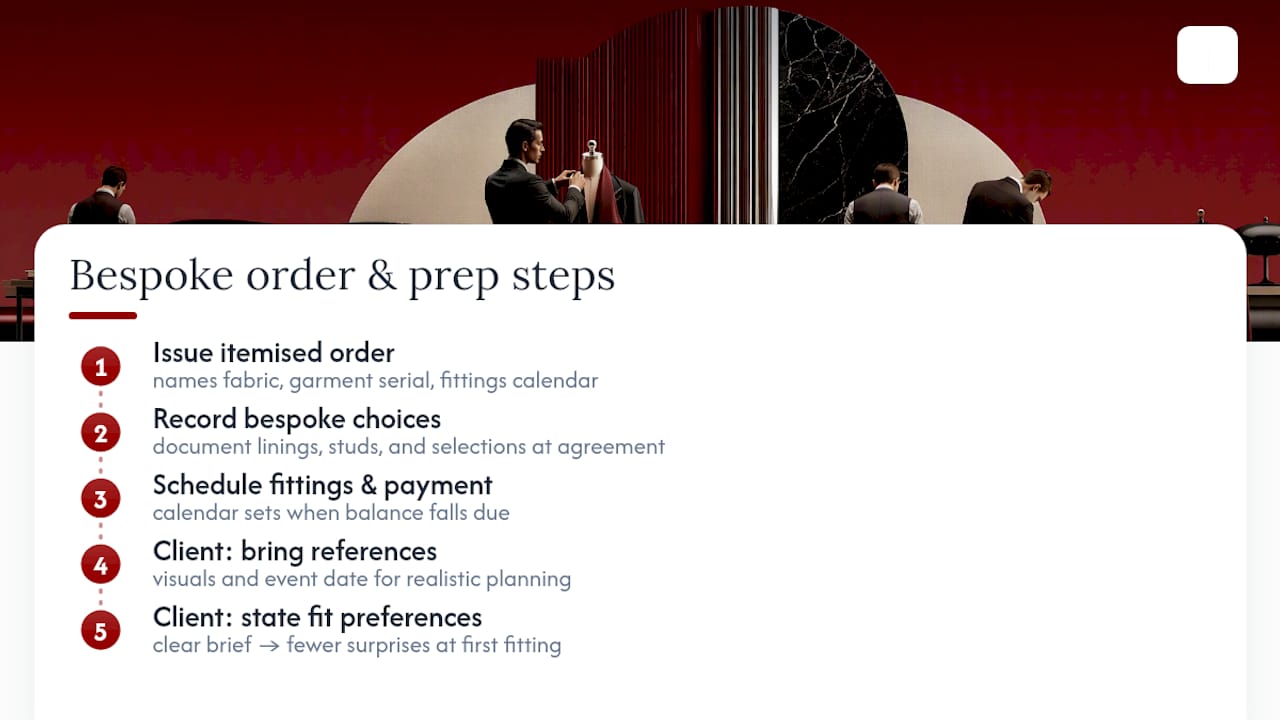
The order we issue is itemised. It names the fabric, records the garment's serial number, and sets out the calendar of fittings against which the balance falls due.
Every bespoke choice, from Egyptian silk hood linings to the alignment of Italian cone studs, is documented at the point of agreement rather than left to memory. That record protects the client's expectations and the atelier's craft in equal measure.
Pro Tip: Arrive at your consultation with visual references and, where relevant, an event date. It lets the atelier plan a realistic calendar rather than compressing skilled work into a rushed window.
Bring fit preferences too. The clearer the brief, the fewer surprises at the first fitting.
Why Jeeyodee asks for a deposit before a single cut is made
We ask for a caparra because a limited production run cannot be reassembled once materials are committed. Each piece we make is numbered, produced once, and never repeated, so the deposit is not a formality. It is the moment a client's conviction and our craft time become inseparable.
Fairness runs both ways. Our correction policy is set out before the first cut, and our fitting calendar is agreed, not improvised. A client who understands the terms from the outset rarely needs to invoke them.
Permanence deserves precision at every stage, including the paperwork that precedes it.
— Jeeyodee
Commissioning a made-to-measure piece from Maison Jeeyodee
Where a ready-made drop asks you to choose from what already exists, a bespoke commission with Jeeyodee begins with a conversation, not a size chart.

If a particular silhouette or detail from a past collection has stayed with you, our measurement guidance explains what we need from you before the first consultation, and readers who want a technical grounding in how garments are measured can also consult this guide to vertical and horizontal measurements. To begin, request the maison's order facsimile and book your consultation through Jeeyodee, where deposit instructions and current availability are confirmed directly.
Selected primary sources and templates
Readers wanting to check their own commission against the legal and practical standard should go directly to source material rather than take an atelier's word for it.
- Article 1385 of the Civil Code, for the statutory basis of the caparra confirmatoria and its remedies
- A practical facsimile for a garment sale, showing the wording an itemised order should contain
- Legal guidance for fashion businesses in Italy, covering drafting and proportionality
- Dover Street's sartoria pages, for a working example of the su misura process from consultation to delivery
Sources
- Articolo 1385 del Codice Civile
- Gliesempi
- Legal guidance for fashion businesses in Italy — Italian Business Lawyers
- Dover Street — sartoria su misura e studio modellistico
FAQ
What is the average cost of a sarta or bespoke atelier?
Costs vary widely by fabric, complexity and the atelier's reputation, and no single figure applies across Italy.
What is the difference between a sartorial suit and one described as su misura?
"Su misura" refers to a garment cut and constructed specifically to an individual's measurements and preferences, while "sartorial" more broadly describes tailoring craftsmanship. In practice, a genuine su misura commission always involves fittings and adjustment, which distinguishes it from adjusted ready-to-wear.
How much does it cost to have a dress made by a sarta?
Pricing depends on fabric, handwork and the number of fittings required, so there is no fixed figure that applies to every commission.
What does "Made in Italy" actually guarantee?
Jeeyodee's own pieces are handcrafted in Italy and individually numbered, which goes beyond the label to give each garment a traceable, one-off provenance.
Can an atelier keep my deposit if I cancel the commission?
Where the deposit is properly labelled a caparra confirmatoria in a written order, the atelier can generally retain it if the client withdraws without valid reason, provided the sum was proportionate to the commission. Disputes over proportionality are typically resolved through direct negotiation first, and through mediation or litigation only when that fails.