
TL;DR:
- Small batch fashion produces limited garment runs based on actual demand, reducing overproduction and waste. It also supports ethical manufacturing by fostering skilled craftsmanship, fair wages, and durable quality. Localized supply chains enable faster restocking and lower environmental impact, making small batch the sustainable choice.
Small batch fashion is defined as the production of limited garment runs, typically between 10 and 500 units per style, calibrated directly to genuine consumer demand. This discipline is why small batch fashion is sustainable at its core: it removes the structural conditions that cause overproduction. The global fashion industry produces 80 to 150 billion garments annually, with approximately one third never sold and 92 million tonnes of textile waste generated each year. That figure is not an abstraction. It represents the direct consequence of bulk production systems that manufacture to forecast rather than to fact. Small batch production, by contrast, manufactures to evidence. The result is less waste, higher quality, and a more honest relationship between maker and wearer.
Why small batch fashion is sustainable: the overproduction problem
Overproduction is the original sin of the modern fashion industry. Bulk manufacturing commits factories to thousands of units per style before a single customer has expressed interest. When those garments do not sell, brands face a binary choice: discount heavily or destroy stock. Both outcomes carry significant environmental and financial cost.
Small batch production runs of 10 to 500 units per style change this calculus entirely. Brands test the market with limited quantities, observe actual sales behaviour, and restock only what performs. That sequence replaces speculation with discipline.
The financial logic reinforces the environmental one. Unsold inventory triggers markdowns that erode brand value and train consumers to wait for sales. Small batch production removes the largest financial risk in apparel by using real sales data to guide each subsequent production decision. Fewer units are made. Fewer units are wasted. The two outcomes are inseparable.
Pro Tip: When evaluating a brand's sustainability credentials, ask whether it produces to forecast or to confirmed demand. The answer reveals more about its environmental impact than any marketing claim.
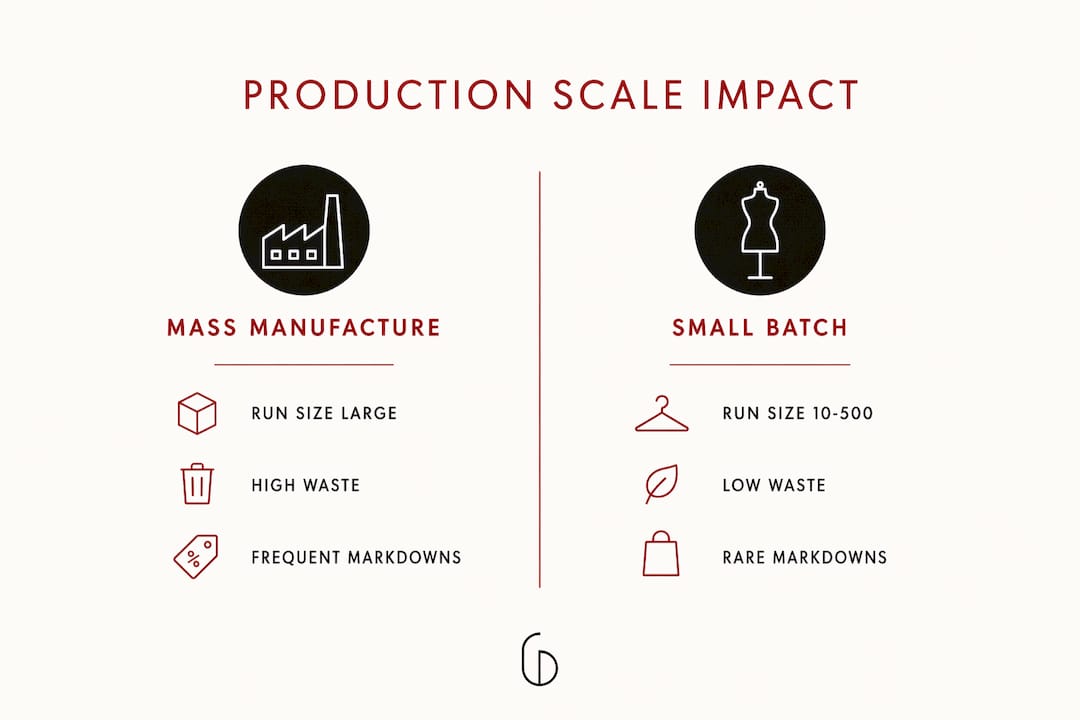
The table below illustrates how production scale directly shapes waste outcomes across different manufacturing models.
| Production model | Typical run size | Unsold inventory risk | Markdown frequency |
|---|---|---|---|
| Mass market bulk | 10,000+ units per style | Very high | Seasonal and constant |
| Mid-tier commercial | 1,000–5,000 units per style | Moderate to high | Regular |
| Small batch | 10–500 units per style | Low | Rare |
| On-demand | 1 unit per confirmed order | Near zero | None |
The pattern is clear. As run sizes decrease, so does the structural pressure to discount and discard. Small batch sits at the point where commercial viability and environmental responsibility genuinely converge.
Does small batch fashion support ethical manufacturing?
The answer is yes, and the mechanism is straightforward. Smaller production volumes require skilled workshops rather than high-volume factories optimised for speed above all else. That shift in production environment changes the conditions under which garments are made.
Skilled workshops employ artisans whose expertise commands fair wages. The work is slower, more considered, and more accountable. Each unit receives attention that bulk production cannot afford to give. The result is a garment built to last rather than built to be replaced.
Higher per-unit costs in small batch production reflect a genuine transfer of value. Fixed costs like pattern-making and factory setup are spread across fewer units, which raises the price per garment. That price, however, buys durability. A garment worn 200 times at a higher purchase price costs less per wear than a cheap alternative discarded after ten uses. The quality over quantity principle is not sentiment. It is arithmetic.
The ethical and quality gains from limited production include:
- Fair wage allocation: smaller workshops distribute labour costs more equitably across fewer, more skilled workers.
- Safer working conditions: artisan-scale production avoids the pressures of high-volume quotas that compromise worker safety.
- Superior material selection: small batch brands source exceptional fabrics because quality per unit matters more than cost per unit.
- Longer garment lifespan: meticulous construction extends the useful life of each piece, reducing replacement frequency.
- Reduced chemical use: smaller dye runs and fabric treatments generate less effluent than industrial-scale processing.
Pro Tip: Look for brands that name their manufacturing partners and describe their production process in specific terms. Vague claims about 'ethical production' without named ateliers or production locations are rarely verifiable.
Craftsmanship in fashion endures precisely because it is rooted in accountability. When a maker knows every unit will be scrutinised, the standard of work rises accordingly.
How do localised supply chains make small batch fashion more sustainable?
Geography matters in fashion production. When manufacturing sits close to the consumer market, brands can restock proven styles within 2–4 weeks rather than waiting months for overseas shipments. That speed eliminates the need to over-order as a buffer against supply chain delays.

The "bullwhip effect" describes how small fluctuations in consumer demand become amplified distortions as they travel up a long supply chain. A retailer orders slightly more to be safe. The distributor orders more still. The factory produces far more than the market actually needs. Local production shortens that chain and dampens the distortion at its source.
Regional textile clusters demonstrate this principle in practice. The following factors define how localised production sustains both quality and environmental responsibility:
- Heritage craft preservation. Clusters like Hawick in the UK and northern Portugal sustain generations of specialist knowledge in weaving, finishing, and construction that cannot be replicated in high-volume offshore facilities.
- Reduced transport emissions. Shorter distances between mill, atelier, and consumer lower the carbon cost of each garment's journey to market.
- Responsive restocking. Producing garments closer to consumers allows brands to restock only what sells, cutting overproduction and environmental footprint simultaneously.
- Supply chain resilience. Local networks are less vulnerable to the global disruptions that force bulk manufacturers to over-order as insurance against delay.
- Cultural sustainability. Preserving regional craft traditions sustains communities and maintains the human knowledge that makes exceptional garments possible.
Italy's atelier tradition exemplifies this model. Workshops in regions such as Campania and Tuscany have produced luxury garments for generations, combining proximity to European markets with craft standards that mass production cannot match. Jeeyodee produces exclusively in Italy for precisely these reasons. The decision is not aesthetic. It is a commitment to the conditions that make genuine quality possible.
What are the real challenges of small batch sustainable fashion?
Honest engagement with small batch production requires acknowledging its constraints. The model is not without friction, and understanding that friction is part of making informed choices as a consumer.
Per-unit costs run 3 to 5 times higher than mass production equivalents. This is not inefficiency. It is the cost of spreading fixed expenses across fewer units while maintaining material and labour standards. The price reflects reality rather than margin.
The challenges worth understanding include:
- Material minimum orders. Mills set minimum order quantities for fabrics that can exceed what a small batch brand needs for a single run. Brands must either absorb surplus material costs or compromise on fabric selection.
- Consumer price sensitivity. Buyers accustomed to fast fashion pricing encounter genuine sticker shock. The cost-per-wear argument is correct, but it requires a shift in how consumers think about value.
- Transparency verification. Sustainability claims like 'small-batch' must be verifiable. Regulatory frameworks such as the FTC Green Guides in the United States and equivalent standards in the United Kingdom require that marketing claims be substantiated. Vague language is not sufficient.
- Scaling responsibly. Growth pressure can tempt brands to increase run sizes incrementally, eroding the discipline that makes small batch production meaningful. Maintaining conviction requires resisting that pressure.
Small batch manufacturing helps create a more stable, predictable business model that prioritises long-term brand health over short-term sales volume. That stability is itself a form of sustainability. A brand that survives on conviction rather than volume contributes less to the cycle of overproduction and disposal that defines fast fashion's environmental legacy.
Key takeaways
Small batch fashion is sustainable because it aligns production with real demand, eliminates surplus inventory, and creates the conditions for ethical craftsmanship and durable garments.
| Point | Details |
|---|---|
| Production scale determines waste | Runs of 10–500 units reduce unsold inventory and markdown-driven disposal. |
| Ethical conditions follow smaller scale | Skilled workshops pay fair wages and produce garments built to last. |
| Local supply chains amplify sustainability | Proximity manufacturing enables 2–4 week restocking, cutting overproduction. |
| Higher unit cost reflects genuine value | Per-unit costs are 3–5 times higher, but cost-per-wear favours quality garments. |
| Transparency is non-negotiable | Sustainability claims must be verifiable under recognised regulatory standards. |
Jeeyodee's conviction: why we make less, and always will
The question of why small batch fashion is sustainable is, for us, not a strategic consideration. It is the only way we know how to work with integrity.
We have watched the fashion industry treat volume as virtue for decades. The logic is seductive: more units mean lower costs, lower costs mean wider access, wider access means greater relevance. What that logic omits is the cost borne by the garments never worn, the workers never fairly compensated, and the materials never honoured.
At Jeeyodee, every piece is produced once. It carries a number. It is made in Italy by hands that understand what they are making and why. The Egyptian silk lining, the Italian cone studs aligned with the kind of patience that bulk production cannot accommodate: these are not details. They are the argument. When you hold a garment that was made with that degree of attention, the case for responsible luxury fashion becomes self-evident.
Conscious consumerism in fashion is not about buying less for its own sake. It is about understanding that what you choose to own becomes part of what you stand for. A garment made in a limited run, by skilled hands, from exceptional materials, is a permanent chapter in a story worth telling. We believe that story matters more than the number of units sold.
— Jeeyodee
Numbered luxury, made slowly: Jeeyodee's small batch collections
Jeeyodee was built on the conviction that a garment worth making is worth making once, and making exceptionally well.

Every piece in the Jeeyodee atelier is produced in a strictly limited run, individually numbered, and never reproduced. The Thorns variants, hand-finished in Italy with heavyweight cotton and a deep red Egyptian silk interior, embody what small batch production makes possible: a level of attention that mass manufacturing structurally cannot achieve. Each drop is a singular event. When it is gone, it is gone. That permanence is not a marketing device. It is the natural consequence of making with discipline and conviction. Explore the current collection at Jeeyodee and own something that was made to endure.
FAQ
What does small batch fashion mean?
Small batch fashion refers to producing limited garment runs of typically 10 to 500 units per style, calibrated to actual demand rather than forecast volumes. This approach contrasts with mass production, which manufactures thousands of units per style regardless of confirmed sales.
Why is small batch production better for the environment?
Small batch production reduces overproduction, which is the primary driver of the 92 million tonnes of textile waste the fashion industry generates annually. By manufacturing only what the market demonstrably needs, brands eliminate the surplus that ends up in landfill or incineration.
Is small batch fashion more expensive, and is it worth it?
Small batch garments cost 3 to 5 times more per unit than mass-produced equivalents because fixed costs are spread across fewer pieces. The cost-per-wear calculation favours small batch clothing, as higher construction quality extends garment lifespan significantly.
How do I know if a brand genuinely practises small batch production?
Look for brands that publish specific production run sizes, name their manufacturing partners, and provide verifiable information about their supply chain. Regulatory standards in the UK and the United States require that sustainability claims be substantiated, so credible brands can evidence their processes.
Does small batch fashion support better working conditions?
Small batch production relies on skilled workshops rather than high-volume factories, which creates conditions more conducive to fair wages and safer working environments. The per-unit economics of small batch production allocate more value to skilled labour rather than compressing it.