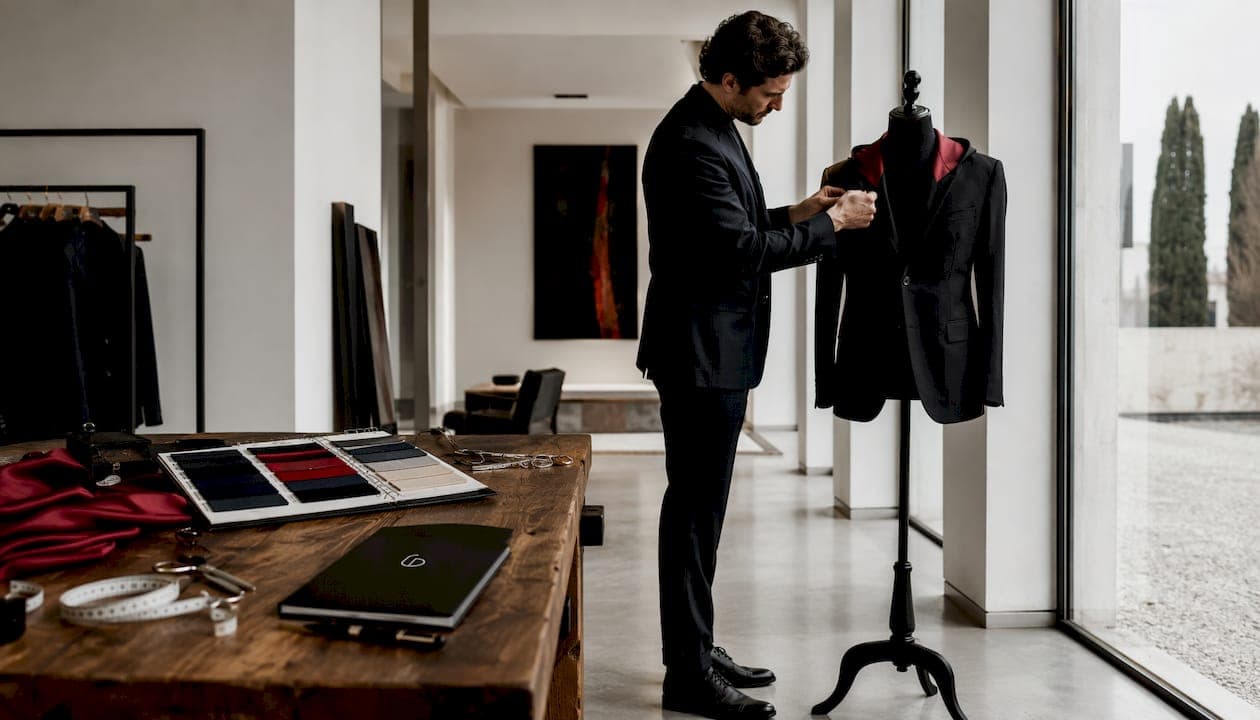
TL;DR:
- Bespoke fashion involves creating garments from scratch based on an individual’s precise measurements and style preferences. It ensures the highest fit accuracy by designing a unique pattern, lasting over a decade with proper care. The process emphasizes craftsmanship, sustainability, and personalization, setting it apart from made-to-measure and ready-to-wear clothing.
What is bespoke fashion, and how does it differ from other tailoring?
Bespoke fashion is clothing created entirely from scratch to an individual's precise measurements, posture, and stylistic preferences, with no pre-existing pattern involved. The word itself derives from the verb bespeak, meaning to speak for something or give order for it to be made. Fashion terminology has long reserved the term for individually patterned and crafted garments, the menswear equivalent of women's haute couture.
The distinction between bespoke and its near neighbours is not merely semantic. Three categories define the tailoring spectrum:
- Bespoke: A new pattern is drafted from scratch for each client, often from 20 or more measurements, with multiple fittings and extensive hand finishing. No two bespoke patterns are identical.
- Made-to-measure: An existing block pattern is adjusted to approximate the client's measurements. Fit is improved over ready-to-wear, but the structural foundation is shared.
- Ready-to-wear: Factory-produced in standardised sizes, designed for the statistical average rather than any individual body.
The critical differentiator is pattern creation. Bespoke constructs; made-to-measure adapts; ready-to-wear assumes. That hierarchy of precision explains why bespoke remains the highest standard in tailoring, accommodating physical asymmetries, posture variations, and proportional nuances that adjusted standard patterns simply cannot address.
How bespoke tailoring evolved in Britain
The story of bespoke tailoring is, in many ways, the story of Savile Row. That single street in London's Mayfair became the pinnacle of tailoring in the 19th century, earning the title "the Golden Mile of tailoring" and establishing the standards that still define the craft globally.
Key moments in its evolution:
- Early 19th century: Savile Row establishes itself as the address for English gentlemen's tailoring, with houses developing the structured frock coat and later the lounge suit.
- Late 19th century: A grey area emerges as some tailors begin measuring clients but producing garments to the nearest standard size, blurring the line between bespoke and what would become made-to-measure.
- Early 20th century: The rise of ready-to-wear and industrial mass production forces a clearer distinction. Bespoke becomes explicitly associated with higher quality and greater cost.
- Mid-20th century: Savile Row dresses heads of state, film stars, and royalty, cementing bespoke's cultural authority beyond mere utility.
- June 2008: The Advertising Standards Authority rules on a disputed use of the word "bespoke," citing the Oxford English Dictionary's definition of "made to order." The ruling formalises a broader, less traditional interpretation, though the older distinction with made-to-measure is acknowledged.
- 21st century: A renewed appreciation for craft and permanence, partly in response to fast fashion's environmental cost, brings bespoke back into cultural conversation as a considered, deliberate act of consumption.
The tradition has never been static. What Savile Row codified, each generation has reinterpreted, yet the founding principle, that a garment should be built for one body alone, has not changed.
The bespoke tailoring process, step by step
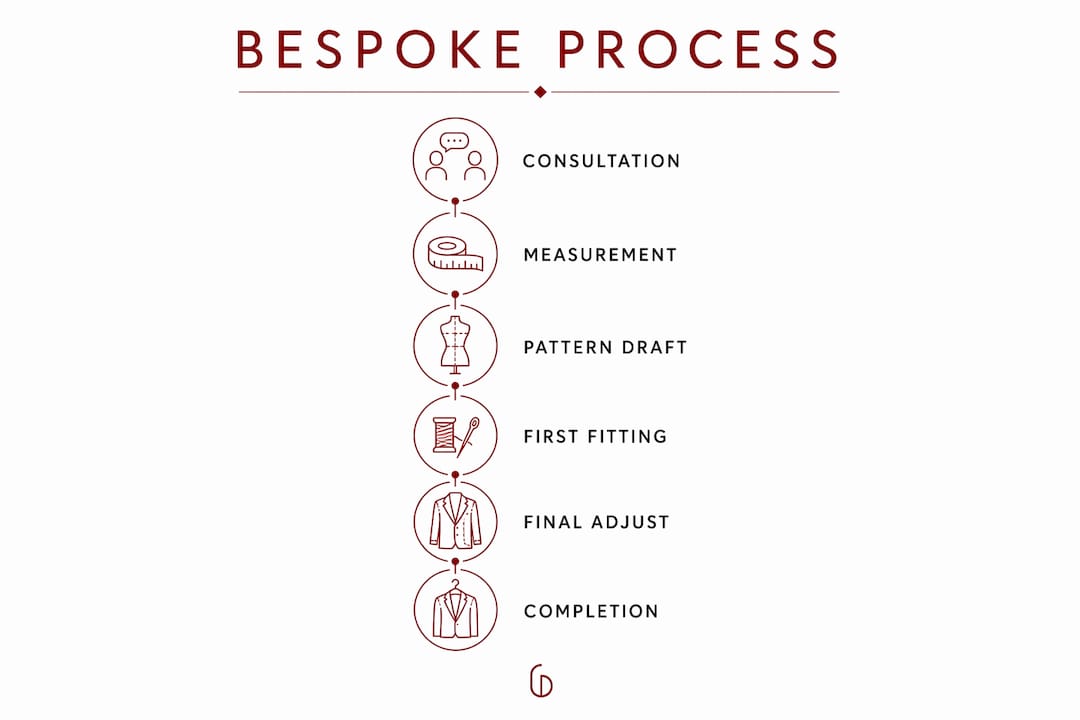
The bespoke process typically spans 2–3 months and involves 2–3 fittings, though complex commissions may require more. Each stage is deliberate, and none can be rushed without compromising the result.
- Consultation: Client and tailor discuss fabric, lining, silhouette, and functional requirements. A skilled tailor observes posture, lifestyle, and aesthetic aims, treating the commission as a functional extension of the individual.
- Measurement: Detailed body measurements are recorded, covering not just chest and waist but shoulder slope, arm rotation, torso length, and postural asymmetries.
- Pattern drafting: A unique paper pattern is created from scratch, built entirely around the client's recorded dimensions. This is the act that defines bespoke.
- Cutting: The chosen cloth is chalked and cut by hand using shears, guided by the individual pattern.
- Basting: The garment is loosely assembled in its rough form, ready for the first fitting.
- First fitting: The basted garment is tried on. The tailor marks adjustments directly onto the cloth, assessing how the structure interacts with the living body.
- Further fittings: Subsequent fittings refine the fit progressively, addressing collar roll, shoulder seam placement, and trouser break.
- Hand finishing: Buttonholes, lapels, and structural details are finished by hand, including the internal canvas work that gives the garment its character.
- Delivery: The completed garment is pressed and presented. The pattern is archived for future commissions.
Pro Tip: Ask your tailor to show you the internal canvas construction before the lining is sewn in. The quality of the pad stitching across the chest and lapel tells you more about the garment's longevity than any fabric specification.
Bespoke, made-to-measure, and ready-to-wear compared
The three categories are often conflated in marketing, but their practical differences are considerable. Understanding them helps you commission with clarity.
| Feature | Bespoke | Made-to-measure | Ready-to-wear |
|---|---|---|---|
| Pattern origin | New pattern, drafted from scratch | Existing block pattern, adjusted | Standard pattern, fixed sizes |
| Fit precision | Highest; accommodates all asymmetries | Good; limited structural adjustment | Average; designed for statistical norm |
| Construction | Largely handcrafted, floating canvas | Mixed; some hand finishing | Machine-made |
| Customisation | Complete: fabric, cut, lining, details | Moderate: fabric and some details | None |
| Fittings | 2–3 or more | Usually 1 | None |
| Production time | 2–3 months | 2–3 months | Immediate |
| Typical use | Suits, formal wear, special commissions | Business wear, occasion dressing | Everyday, casual, fast fashion |
Made-to-measure is alteration. Bespoke is creation. The distinction is not snobbery; it is a description of what actually happens in the workroom.
How bespoke accommodates your body and personal style
No two bodies are symmetrical. One shoulder sits higher than the other; one arm rotates differently; posture shifts with age and habit. Ready-to-wear ignores all of this. Bespoke accommodates every asymmetry, from shoulder slope to torso length, producing a garment that moves with the body rather than against it.
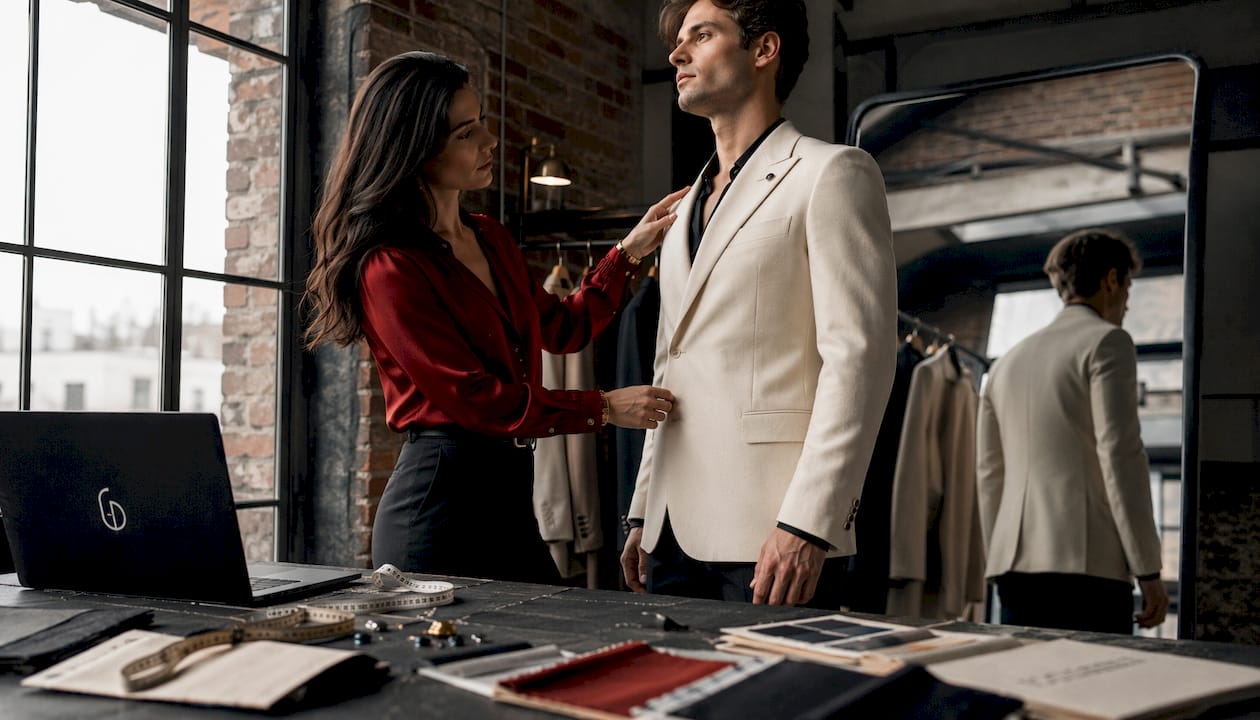
Expert tailors describe well-fitted bespoke clothes as garments that "disappear" on the wearer. There is no lifting at the back when you raise your arms, no collar gap, no pulling across the chest. The suit holds you without announcing itself.
When commissioning bespoke, consider the following:
- Posture and physical asymmetries: Inform your tailor of any known differences between left and right sides, including shoulder height and hip alignment.
- Lifestyle requirements: A garment worn in boardrooms demands different construction from one worn at social events or on long-haul travel.
- Fabric weight and drape: Heavier cloths suit structured silhouettes; lighter weights work for warmer climates or more relaxed cuts.
- Lining and interior details: Lining colour, monograms, and button choice are personal signatures invisible to most observers but deeply meaningful to the wearer.
- Silhouette preferences: Chest suppression, lapel width, and trouser break all communicate something about the wearer's character. Discuss these deliberately.
Bespoke also extends beyond the suit. Wedding garments, overcoats, evening wear, and even personal accessories can be commissioned to the same standard, each piece becoming a considered statement of identity.
The cost of bespoke clothing and its long-term value
Bespoke commands a higher price than any other tailoring category, and that cost is honest. It reflects the hours involved, the quality of materials, and the skill of the artisan. A single bespoke suit from a Savile Row house typically requires a substantial number of hours of skilled work across the full commission.
The economic case for bespoke rests on longevity. With proper maintenance, bespoke garments have a notably long lifespan, often lasting 10 or more years. Measured per wear, quality construction is often the least expensive clothing you will ever own.
Factors that influence bespoke pricing include:
- Fabric selection: Mill-sourced long-staple wools, fine silks, and high-grade cottons carry a premium over commercial cloth.
- Construction method: Fully hand-stitched floating canvas costs more than fused or half-canvas alternatives.
- Number of fittings: More fittings mean more tailor time, which is reflected in the final price.
- Complexity of design: Unusual cuts, intricate linings, or detailed hand finishing add to the commission cost.
- Tailor's reputation and location: Savile Row commands the highest prices; independent ateliers may offer comparable craft at lower rates.
The sustainable luxury wardrobe is built on exactly this logic: fewer pieces, better made, worn for decades rather than seasons.
Why bespoke clothing supports sustainable fashion
Bespoke is, by its nature, a sustainable act. Every garment is cut only when ordered, eliminating the overstock and unsold inventory that defines fast fashion's waste problem. No units are produced speculatively. No fabric is cut for a garment that will never be worn.
The sustainability argument for bespoke rests on several pillars:
- Premium materials age gracefully: Long-staple wool, fine silk, and high-grade cotton resist pilling, hold their structure, and improve with careful wear rather than degrading.
- Zero overproduction: Bespoke garments are made to order, meaning no surplus stock ends up in landfill.
- Skilled pattern cutting minimises waste: An experienced cutter works the cloth efficiently, reducing offcuts to a minimum.
- Extended lifespan reduces replacement frequency: A garment worn for a decade replaces ten fast-fashion purchases, with a fraction of the cumulative environmental cost.
- Support for artisan workshops: Many bespoke commissions are fulfilled by small, specialist workrooms, sustaining craft skills that would otherwise disappear.
The longevity of luxury garments is not accidental. It is the direct consequence of choosing materials and construction methods that were never designed to be disposable.
Craftsmanship and identity in bespoke fashion: insights from Maison Jeeyodee
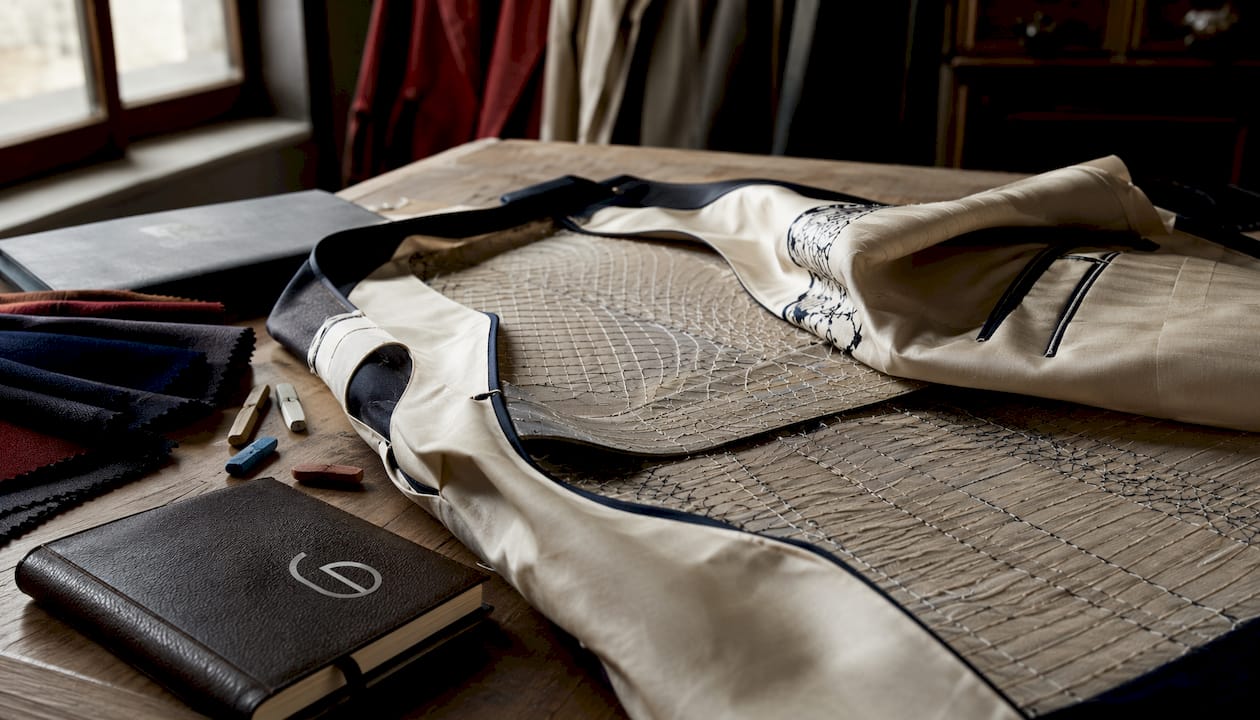
At the heart of bespoke tailoring lies a structural technique invisible to the eye but felt with every wearing. The floating canvas is a layer of horsehair and wool, hand-stitched to the cloth in tiny pad stitches across the chest and lapel. Unlike a fused interlining, which bonds permanently to the face cloth and eventually separates, the floating canvas moulds itself to the wearer's body over time. The garment does not merely fit; it learns.
The bespoke relationship is equally cumulative. A tailor archives the client's pattern and refines it with each subsequent commission, adjusting for changes in posture, weight, or shoulder alignment. A wardrobe built over decades with one tailor fits better at sixty than it did at forty.
Bespoke also builds identity in a way that ready-to-wear cannot. Control over every detail, from fabric to button placement, produces a garment that reflects the wearer's character rather than a brand's seasonal directive.
- Floating canvas construction moulds to the body over years, improving comfort and silhouette with wear.
- Archived patterns allow future commissions to begin from a refined foundation rather than from scratch.
- Hand-stitched details at buttonholes, lapels, and sleeve heads carry the mark of individual craft.
- Fabric and lining choices become a private language, visible only to those who know where to look.
At Maison Jeeyodee, we hold this philosophy as a founding conviction. Each piece produced at our Italian atelier is individually numbered and never reproduced, because a garment conceived for permanence deserves to exist as a singular object. The craftsmanship that endures is not the craftsmanship that shouts. It is the kind built into the structure, felt in the weight of the cloth, and understood only after years of wearing.
Pro Tip: When examining a bespoke jacket, press gently on the chest panel. A floating canvas will feel slightly springy and independent from the face cloth. A fused interlining will feel rigid and bonded. That difference, invisible from the outside, determines how the garment ages.
Bespoke terminology you should know
The language of bespoke tailoring carries precision. Understanding the key terms helps you commission with confidence and recognise quality when you encounter it.
Baste: A temporary, loose assembly of the cut cloth used for the first fitting. The basted garment is not finished; it exists solely to assess fit and proportion before permanent construction begins.
Floating canvas: The internal structure of a bespoke jacket, made from horsehair and wool, hand-stitched to the face cloth. It shapes the chest and lapel and improves with wear.
Fused interlining: A cheaper alternative to floating canvas, bonded to the face cloth with adhesive. It provides initial structure but degrades over time and cannot adapt to the body.
Block pattern: The standard-sized template used in made-to-measure tailoring, adjusted to approximate a client's measurements. Bespoke uses no block pattern.
Bespeak: The archaic verb from which "bespoke" derives, meaning to give order for something to be made. The word entered tailoring vocabulary on Savile Row.
Toile: A test garment made in inexpensive cloth, used to assess fit before cutting the final fabric. More common in couture than in traditional Savile Row bespoke.
Pad stitching: The hand-stitching technique used to attach the floating canvas to the face cloth, creating the chest roll and lapel shape characteristic of bespoke construction.
Break: The fold of trouser fabric at the shoe. The degree of break, from no break to full break, is a stylistic choice made during the commission.
Famous bespoke fashion houses and designers
Savile Row remains the most recognised address in bespoke tailoring, and several houses on that street have shaped the craft's global reputation.
Henry Poole & Co. is widely credited as the founding house of Savile Row, having moved to the street in 1846. The firm is said to have introduced the dinner jacket to society, reportedly at the request of the Prince of Wales in the 1860s.
Anderson & Sheppard is known for its soft, draping house style, a silhouette that influenced generations of tailors and clients who favoured ease over structure. The house has dressed figures from Fred Astaire to Prince Charles.
Huntsman represents the opposite tradition: a structured, suppressed silhouette with a single-button front, considered one of the most distinctive house styles on the Row.
Gieves & Hawkes at No. 1 Savile Row has dressed the British military and royal family for centuries, holding three Royal Warrants at various points in its history.
Beyond Savile Row, Neapolitan tailoring houses in Naples, Italy, developed a distinct tradition characterised by a softer shoulder, lighter construction, and a more relaxed chest. The Neapolitan school, associated with names such as Kiton and Cesare Attolini, represents a parallel lineage of bespoke excellence that has profoundly influenced contemporary luxury tailoring.
In women's fashion, the equivalent of bespoke is haute couture, governed in France by the Chambre Syndicale de la Haute Couture, which sets strict standards for what may legally be called couture, including hand sewing, in-house atelier production, and a minimum number of fittings.
How to care for bespoke garments
A bespoke garment is an investment in permanence. Its longevity depends as much on how you care for it as on how it was constructed.
Rest garments between wearings. A suit worn on consecutive days does not have time to recover its shape. Hanging it for at least 24 hours on a shaped wooden hanger allows the fibres to breathe and the canvas to reset.
Brush the cloth after each wearing with a natural-bristle garment brush, working with the weave. This removes surface dust before it settles into the fibres and dulls the cloth's appearance over time.
Dry cleaning should be used sparingly, no more than once or twice a season for a regularly worn suit. Frequent dry cleaning strips the natural oils from wool fibres, accelerating wear. Spot cleaning and airing are preferable for minor marks and odours.
Press with care. A bespoke garment should be pressed with a damp cloth between the iron and the fabric, using steam rather than direct heat. Pressing too aggressively flattens the canvas and removes the natural roll of the lapel. When in doubt, take the garment to a professional presser who understands tailored construction.
Store suits in breathable cloth bags, never plastic. Plastic traps moisture and can encourage mildew in natural fibres. Cedar blocks or sachets deter moths without the chemical residue of mothballs. For long-term storage, a cool, dry wardrobe away from direct light preserves both colour and structure. The handcrafted luxury wardrobe demands this level of attention, and rewards it with decades of service.
Common fabrics and materials used in bespoke fashion
The cloth is where a bespoke commission begins. Every other decision, silhouette, lining, construction, follows from the fabric chosen in the first consultation.
Wool is the foundation of bespoke tailoring. Long-staple wool from mills such as Loro Piana, Scabal, and Holland & Sherry offers exceptional durability, natural breathability, and a drape that synthetic fabrics cannot replicate. Super numbers (Super 100s, Super 120s, and above) indicate finer yarn, producing lighter, more lustrous cloth at the cost of some durability.
Cashmere is used for overcoats and occasional suiting where softness and warmth take precedence over resilience. Pure cashmere is delicate; blends with wool offer a more practical balance.
Linen suits warm-weather commissions. It creases readily, which purists consider part of its character, and breathes better than any other suiting fabric in high temperatures.
Silk appears most often in linings, where its smooth surface allows the jacket to move freely over a shirt or blouse. Silk linings also regulate temperature and carry a tactile quality that synthetic alternatives cannot match. At Jeeyodee, Egyptian silk is used for hood linings, a material chosen for its exceptional fineness and the quiet authority it lends to the interior of each piece.
Cotton in heavier weights serves for casual suiting and summer jackets. Heavyweight cotton holds structure without the formality of wool, making it well suited to garments that occupy the space between tailoring and relaxed luxury.
The lining, buttons, and canvassing materials complete the picture. Horn and mother-of-pearl buttons age beautifully and carry a tactile weight that plastic cannot approximate. These details are not decorative flourishes. They are the evidence of conviction.
Maison Jeeyodee: numbered luxury, made slowly
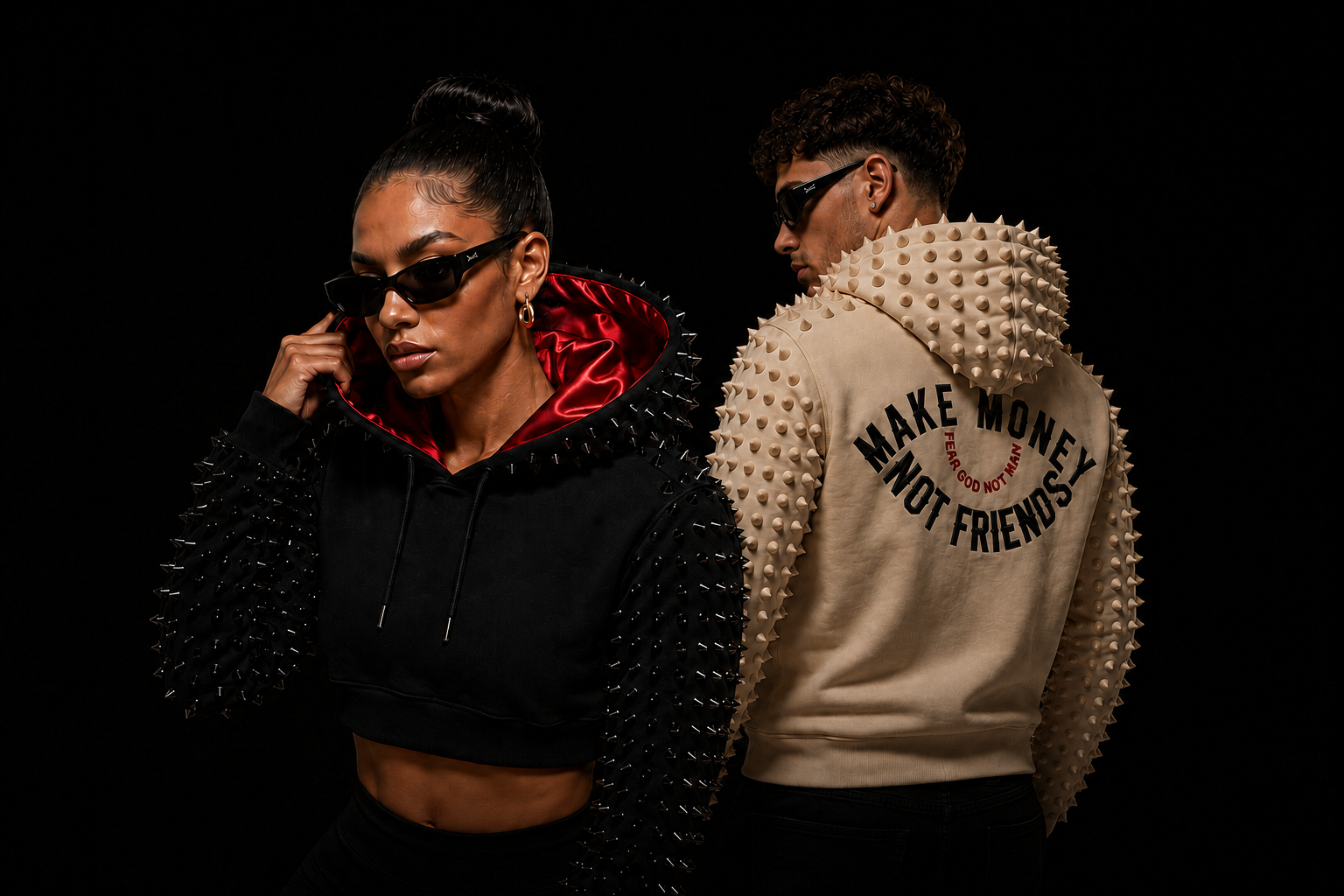
Bespoke fashion, at its most considered, is not a service. It is a philosophy: that a garment should be built for one person, made with complete conviction, and designed to outlast the season in which it was conceived.
Maison Jeeyodee was founded on that same conviction. Every piece produced at our Italian atelier is individually numbered, handcrafted, and never reproduced. The Egyptian silk interior, the meticulously aligned Italian cone studs, the heavyweight cotton shell: each element is chosen because it belongs, not because it is expected. Ownership becomes attachment. Attachment becomes permanence.
Explore the current collection at Jeeyodee and discover what it means to wear something made slowly, made once, and made entirely for you.
Key takeaways
Bespoke fashion is the only tailoring category that creates a new pattern from scratch for each individual, producing garments that accommodate physical asymmetries, last 10 or more years with proper care, and eliminate the overproduction that defines fast fashion.
| Point | Details |
|---|---|
| Bespoke defined | Clothing cut from a new, individual pattern with no pre-existing template involved. |
| Process duration | A typical bespoke commission takes 2–3 months and includes 2–3 fittings. |
| Lifespan advantage | With proper maintenance, bespoke garments last 10 or more years, far exceeding fast fashion alternatives. |
| Floating canvas | Hand-stitched horsehair and wool construction moulds to the body over time, improving fit with wear. |
| Sustainability | Every bespoke piece is cut to order, eliminating overstock and reducing fabric waste. |
FAQ
What does bespoke mean in fashion?
Bespoke describes clothing made entirely from scratch to an individual's measurements, with a unique pattern drafted for each client. The term originates from Savile Row and is the menswear equivalent of haute couture.
What is the difference between bespoke and tailoring?
All bespoke garments are tailored, but not all tailoring is bespoke. Tailoring is the broader craft; bespoke refers specifically to garments built from a new, individual pattern rather than an adjusted standard one.
Why is bespoke so expensive?
The cost reflects the hours involved, premium mill-sourced fabrics, multiple fittings, and extensive hand finishing. Measured across a long lifespan, the cost per wearing is lower than most fast fashion alternatives.
Does bespoke mean high-end?
Bespoke denotes a specific construction method, not a price point alone. Historically the term meant any garment made to order; today it is associated with the highest level of tailoring, characterised by individual pattern drafting, hand construction, and multiple fittings.
How do you choose bespoke fashion that suits you?
Begin with a clear understanding of your lifestyle requirements, then discuss fabric weight, silhouette, and construction with your tailor. Inform them of any physical asymmetries, and treat the first consultation as a conversation rather than a transaction. The relationship, and the fit, improves with time.